Showing posts with label history. Show all posts

Sunday, November 30, 2008

Black Book (2006)


(Image from IMP Awards)


Black Book (2006)

The gorgeous Carice van Houten is easily one of the main draws of 'Black Book', and not just because of her looks but because her stellar performance is the highlight of an otherwise unexceptional film. Van Houten plays Rachel Stein, a Jewish woman in the Netherlands during World War II who, after the brutal murder of her family, joins the Dutch resistance and infiltrates the Gestapo headquarters in The Hague. There she seduces the officer in charge, Ludwig Müntze (Sebastian Koch), but starts to fall for him when she realizes that he's actually a decent sort who likes to collect stamps instead of kill people. When the resistance uses her to try and help some captured prisoners while also trying to figure out who has been selling out Jews - like Rachel's parents - to the Nazis, she finds herself in an increasingly dangerous position.

Paul Verhoeven is the master of gratuitous violence, nudiy, and sex, and he doesn't dissapoint with this film, and neither does van Houten. Puerile elements aside, the journey Rachel goes through is harrowing and van Houten completely sells the character and her predicament, being sympathetic and convincing as a resourceful woman forced to go to extremes for the cause. She is by far and away the best thing about the film. The rest of it is pretty good as well but doesn't really fire on all cylinders; the film shifts somewhat uncomfortably between historical drama and cheesy action thriller, with the plotting and characterization often being more like a Hollywood summer blockbuster than a sober European war film. Some of the action scenes seem strangely surreal and at odds with the generally realistic tone the film usually maintains.

Having got those negatives out of the way, I can say that 'Black Book' is well acted and visually quite appealing, and while the writing may raise a few chuckles it is still strong enough to make for a gripping experience. As director, Verhoeven manages to conjure some tense scenes and more than a few horrific moments, as he often does, but there's very little in the way of overt humour in the film. Which is a shame, since black comedy is something the man does well, and it wouldn't have been especially jarring since the tone of the film is already fairly erratic.

Overall, a good film that comes across as more superficial and less weighty than most serious WWII movies; still, it's a fine piece of entertainment that features an excellent central performance to hold it together.

Thursday, November 27, 2008

Rabbit-Proof Fence (2002)


(Image from IMP Awards)


Rabbit-Proof Fence (2002)

A true story about three mixed race Aboriginal girls who were taken from their homes and who subsequently escaped their settlement and headed home - a 1500 mile journey along one of Australia's so called 'rabbit proof' fences. The film is credited with igniting debate on the issue of the 'stolen generations', mixed race children who were forcibly 'resettled' away from their families for various misguided reasons. The narrative is about as straightforward as it gets - the three girls are grabbed from their home in one of the film's early and most powerful scenes, and are transported to a settlement for mixed race children; they promptly escape and head for home, and are pursued first by a skilled Aboriginal tracker, and later by the police. Their story becomes something of a sensation throughout Australia, and as a result the girls are given aid by helpful strangers along the way.

It's a simple but emotionally evocative tale - I can't think of a basic narrative that is more immediately engaging than the quest for freedom against improbable odds and the struggle for survival such a quest entails. The cast is full of unknowns - apart from the jarring appearance of Kenneth Branagh - and all of the actors do terrific work, particularly the three girls the story revolves around. The writing hits all the right emotional beats; the characters might be a bit sketchy, but are sufficiently fleshed out for the story they are in. I have one major complaint about the film - the storytelling feels somewhat ordinary, with scenes rarely creating a sense of fear or hopelessness or of awe at how remarkable the girls' journey is. This is probably due more to the somewhat ordinary directing rather than the writing. There are some stunning visuals in there, however, particularly of the desolate and oppressive Australian outback (much like 'The Proposition'!)

'Rabbit Proof Fence' is a well made, inspirational film that falls short of being something truly special, but still packs quite a punch. The fact that it's based on true events does, as is often the case, give it some added gravitas, especially in the epilogue which features some of the real individuals portrayed in the film.

Thursday, May 08, 2008

Bloody Sunday (2002)


(Image from IMP Awards)


Bloody Sunday (2002)

Amazing film - Paul Greengrass really burst onto the scene with 'Bloody Sunday', and he's gone on to make a splash with the last two Bourne films (I reviewed part 2 here) and United 93. Unsurprisingly, this film is as brilliant as I was expecting.

Made in Greengrass' now trademark faux documentary fashion, it takes place during the course of a single day and recreates the Bloody Sunday incident in Derry, Northern Ireland, that took place in 1972. James Nesbitt stars as Ivan Cooper, MP and prominent figure in the Civil Rights Association who has planned a civil rights march despite the British Government prohibiting such activities. The film basically cuts between the march organizers and the military, who are convinced that there will be violence despite all claims to the contrary and consequently bring paratroopers onto the scene in anticipation. Tension mounts as the rally gets underway, and despite the best efforts of the rally organizers a faction becomes agitated by the aggressive military presence and starts to react with violence. This of course soon escalates with tragic results as overzealous soldiers gun down many innocent civilians.

Most of the film is based on established fact, though there is obviously some extrapolation and guesswork thrown in there. It's an even handed recounting of events, representing both sides; yes, the soldiers are ultimately shown as the 'bad guys', but in all fairness when 26 unarmed people are shot with live rounds, some of them in the back, it's hard to imagine a scenario in which these guys simply cocked up.

I think one of the best thing about the film is how it manages to get across the complexity of the situation. No one here is pure 'evil', they are all people with biases and prejudices who believe they are in the right. The military has been experiencing high casualties in the region and the top brass feel the need to assert their authority; the restless local youth detest the military presence and lash out whenever and however they can; the soldiers on the street are angry at the deaths of their colleagues and feel the need to dish out some payback; and of the marchers, while the majority are peaceful some do agitate and incite violence, with a few even packing firearms (presumably members of the IRA).

The script presents all of this effectively and sets all the pieces in place for the bloody massacre that ensues. And it also highlights some simple truths - that the belligerent use of military force invariably leads to resentment from the people, and that the military inevitably dehumanizes everyone - including civilians - and lumps them all into the same boat, resulting in violence that can often be indiscriminate. Which in turn leads to more people lining up to fight them, further fueling a vicious circle of violence. Current events lend weight to the argument that such aggressive strategies are doomed to failure, and that the cost of apparent short term gains will result merely in sowing the seeds of undesirable long term repercussions. I'm no peacenik, but more often than not callous, rampant military actions seem to achieve little besides causing loss of life and continued instability over time.

Subject matter aside, film is exceptionally well made. The feeling of actually being there is what elevates this above a mere recreation of facts - it's the pervasive verisimilitude. The writing and the intense, atmospheric direction completely sell the notion that what is on screen is for real. Greengrass' hand-held photography and austere visuals draw you in - I know some people hate shakey-cam, but it works in some contexts, and I think Greengrass is masterful with his camerawork. As with his other films, this is all very matter-of-fact and doesn't resort to anything showy. It merely presents the event as realistically as possible and allows what is on screen to speak for itself. The behaviour of everyone rings absolutely true, from the soldiers to the military planners to the masses marching, a fact that is brought about by the excellent performances throughout from every actor no matter how insignificant. James Nesbitt is of course the star, and he's absolutely superb as the charismatic, seemingly tireless activist who deep down is weary and just wants to be with his girlfriend. On a side note, most of the people are presented as blank slates but some are given a little background - it's not much, but it adds humanity to what would otherwise be a bunch of strangers.

'Bloody Sunday' is a relatively low budget film that was actually released as a TV movie. It's a masterful, even handed recreation of a historical event that is absorbing and exciting as an entertainment experience but also gives the viewer a deeper insight into the myriad variables that were in play that had a hand in leading to the massacre. While the filmmakers clearly veer towards siding with one group over the other, it's hard to argue against them. When all is said and done however the film is a sobering experience that leaves one with an indelible impression and a lot to dwell upon. Which is always a sign of a great film. Needless to say, highly recommended.

Wednesday, May 07, 2008

The Magdalene Sisters (2002)


(Image from IMP Awards)


The Magdalene Sisters (2002)

'The Magdalene Sisters' is a fictionalized story based on true events that tells of the harrowing experiences of three young women in Ireland during the 1960s when they are sent to a Magdalene Asylum, a Catholic institute run by nuns for 'fallen' women to repent in the manner of Mary Magdalene. Margaret (Anne-Marie Duff) is raped at a wedding, so her shamed family whisks her away to one of the asylums. Rose (Dorothy Duffy) gives birth out of wedlock - her child is immediately put up for adoption and she is sent away. Bernadette (Nora-Jane Noone), a girl at an orphanage, is condemned to an asylum for simply being too attractive and drawing the interest of neighbourhood bosys. The asylum they are sent to - the places were apparently mostly laundries - is run by the cruel Sister Bridget (Geraldine McEwan) who enjoys regularly counting the rolls of money she earns by using her 'inmates' as free labour.

What follows is in many ways predictably formulaic as we are introduced to the harsh routine of the asylum. The focus is mainly on the three new arrivals as well as the slightly flaky Crispina (Eileen Walsh) as they acclimatize to their new surroundings. Initially of course their thoughts are on escape or eventual 'release', but failed attempts and cruel punishments together with the passage of time begin to break their spirits as they resign themselves to their fates. Each of the girls has her own problems and means of coping; and in the same way, the nuns running the place have their own means of keeping their charges in line and dishing out pain and humiliation. Fragile friendships are forged as the young women endure tremendous hardship.

It's not difficult to imagine that this film is based on the true nature of some of these 'asylums', if the human proclivity for exploiting and abusing others is anything to go by. The sheer hopelessness of such a place is hard to imagine, but the film does a very good job of conveying it. It would have been easy to go the typical maudlin route, but despite being devoid of any real surprises there's something stark and truthful about the film that elevates it above other similar fare. The structure of the story is typical, but it manages to avoid being cliched and trite. It's restrained and very moody. And also darkly humorous at times (witness the 'You're not a man of god!' scene in which a priest strips down and runs naked across a field after developing a rash). There isn't much backstory to the characters but we get to know them fairly well during the film's runtime and they are believable and their gradual progression to a state of numb acceptance is quite tragic. The performances are terrific - as with all things in the film, restrained and with a touch of subtlety. Geraldine McEwan's performance as Sister Bridget is particularly noteworthy, with her character usually being quite cold and frightening but on the odd occasion convincingly charming and obsequious. There must be something about playing villains of this nature that brings out the best in actors!

The ending is the only real area where the film disappoints, with a rather facile conclusion that arrives abruptly. I suppose a downbeat conclusion would have been too much, but this felt unearned and unsatisfying. That caveat aside, 'The Magdalene Sisters' is a very good film that presents a bleak look into an immoral (and now thankfully defunct) institution that was bent on trading in human suffering while hiding behind the impenetrable shield of religious righteousness. Somber and hardly popcorn fare, this is a film that deserves serious attention.

Monday, April 28, 2008

Deadwood - Season 2 (2005)


(Image from Wikipedia)


Deadwood - Season 2 (2005)

I'm quite surprised to find myself pleased with my review of the first series of 'Deadwood', and there isn't really much to add to my assessment of the show with regard to this second series, which maintains the same high standards throughout its twelve episodes. In summation, the primary storylines revolve around the possible annexation of Deadwood to the territories of Dakota and the attempted acquisition of much of the gold claims by wealthy businessman George Hearst. But of course the smaller stories and the characters collectively play such a large part in the show, and these include: Swearingen's debilitating illness; Sheriff Bullock's fragily alliance with Swearingen and his affair with Mrs. Garrett, followed by the arrival of his wife and stepson; Hearst's geologist Francis Wolcott's scheming and sexual dalliances; Joanie Stubb's attempts to start her own brothel; Cy Tolliver's alliance with Wolcott in their scheme to buy out people's claims; Mrs. Garrett's troubles with the Pinkerton's and her clashes with Bullock's wife; and Mr. Wu's problems with the 'San Francisco Cocksucker', amongst many others.

What I love about this show is how it's so rich, so full of detail and atmosphere, and populated with such diverse, interesting characters each of whom has their own unique voice and idiosyncrasies, each of whom plays some small but integral part in the big picture. It's all character driven, and there are a myriad little stories that criss cross and interweave, and yet it all ties together so perfectly in the end - it really is a supreme piece of storytelling. True, the pacing is deliberate and there is a dearth of action, but that's not what this show is about. I think it's all kinds of great, even though I have to confess to finding some of the more complex speeches a little hard to follow!

Once again Ian McShane rules the roost with his commanding portrayal of Al Swearingen, whose presence seems so intrinsic to the town that when he approaches the brink of death it's almost like the town itself collectively holds its breath. McShane is terrific, and spews out verbose commentary and foul language like there's no tomorrow, and it's a joy to behold. Timothy Oliphaunt has somewhat less of a presence but is still great, and the added dimensions of his awkward relationship with both his mistress and his wife and son adding to his burdens as town sheriff and Swearingen cohort. Powers Boothe, William Sanderson, Robin Weigert, and Brad Dourif are the other standouts from the regular cast, but one guy stands out above most of the other regulars - Garet Dillahunt, who plays the creepy, disturbed, very intelligent, and very persuasive Francis Walcott. Dillahunt also appeared in the first season as Wild Bill Hickok's killer, and he was excellent in that role, but his character here is as far removed as possible from that one - in fact, it took me a while to realize that it was the same guy! Truly an excellent performance; this guy ought to be one to look out for - he has popped up in 'The 4400' and 'The Sarah Connor Chronicles' as well, and has minor roles in 'The Assassination of Jesse James by the Coward Robert Ford' and 'No Country for Old Men'.

'Deadwood' continues to impress in its second season, and I'm dying to see the third and final batch of 12 episodes. It's disappointing to realize that the series was canceled without some form of finality; reading up on the history of the real Deadwood just can't compare to watching David Milch's foul mouthed dramatization! An exceptional TV series that adds further weight to the argument that HBO are without peer when it comes to gritty, edgy dramatic fare.

Monday, April 07, 2008

Visions of Light (1992)


(Image from Wikipedia)


Visions of Light (1992)

Cinematography is one of those interesting aspects of cinema that doesn't get a lot of attention (it's probably up there with editing) despite being significant to the art of filmmaking. I'll readily confess that my knowledge of cinematography is at the level of pretentious dilettante; I think I know good cinematography even if I can't fully explain why I think it's good. 'Visions of Light' is a documentary that seeks to enlighten its viewers about the key role that lighting and cameras play in cinematic storytelling. It does this by interviewing various current (i.e. 1990s) cinematographers and charting the evolution of the artform from the early part of the 20th century onwards. There are clips galore from various films that are presented as examples of great cinematography, with the interviewees often waxing lyrical about the great films and artists.

It's a pretty good documentary, and is perhaps revelatory for those who don't have even the foggiest notion that camera and lighting and shot composition are important visual elements in a film. Unfortunately, as a fan of film it doesn't really tell me much that I wasn't already aware of to some extent, and it winds up being more of a 'best of' clips reel. Except for a few occasions, it merely reiterates similar generic points about good lighting and shows a few clips. It doesn't often delve into WHY that lighting is great, or how it serves to tell the story. In many ways, it's a tease that keeps the secrets of the artform close to its chest. Which is disappointing. Still, as a summary of the history of cinematography, it's informative and holds your interest. I just wish it had more to offer.

Friday, February 15, 2008

Look, Up in the Sky: The Amazing Story of Superman (2006)


(Image from IMDB)

Look, Up in the Sky: The Amazing Story of Superman (2006)

I haven't got much to say about this, really. It's a fairly informative and seemingly thorough but somewhat dry and ultimately unremarkable documentary about the history of Superman. Released at around the time of 'Superman Returns', it is obviously a tie-in for that film and is narrated by one of its stars, Kevin Spacey. Starting with the origins of the character in the 1930s, it chronicles his various incarnations in media, from the comics through to radio shows, cartoons, TV series, and movies, while also portraying the character and stories as a modern myth that stays relevant by adapting to the social climate of the day. There's plenty of interesting little nuggets, and some downright embarrassing stuff from the character's past. Many people related to the various incarnations of Superman are interviewed; for obvious reasons these tend to be people from Superman's more recent history. One of the disappointing aspects is that many key players fail to make an appearance - I can understand an elder statesman like Gene Hackman not showing up, but Tom Welling seriously had better things to do? All in all, this would have made for a fine extra on the Superman Returns DVD, but doesn't really warrant a separate release.

Tuesday, January 29, 2008

Rome - Season 1 (2005)


Rome - Season 1 (2005)

HBO has a reputation for making some terrific original dramas - 'Band of Brothers', 'Carnivale' and 'Deadwood' were great, and I've heard good things about 'The Wire', 'The Sopranos' (yeah, never seen it!), and 'Six Feet Under'. I therefore knew going in that 'Rome' was going to be at least as lavish and immaculately made as its HBO brethren, most likely more so given its massive budget (apparently one of the most expensive TV series ever made). I just didn't anticipate that I would get hooked as much as I did.

'Rome' is a historical drama about, surprise surprise, Rome circa the first century BC during the time when the Roman Empire was formed under Julius Caesar. For the most part it depicts the activities of major and minor historical figures including Caesar (Ciaran Hinds), Marc Antony (James Purefoy), Marcus Brutus (Tobias Menzies), Pompey Magnus (Kenneth Cranham), Gaius Octavion (Max Pirkis), Atia of the Julii (Polly Walker), and Servilia of the Junii (Lindsay Duncan). The politics, relationships, family life, loves, affairs, plotting and scheming of these people are all depicted in dramatic and complex detail, all of it fitting in with the broader historical events taking place . The aforementioned people represent the ruling classes; the central characters of the show, however, are two common soldiers, Lucius Vorenus (Kevin McKidd) and Titus Pullo (Ray Stevenson), two essentially fictional characters who bind the events of the narrative together (in a somewhat contrived fashion, but the contrivance is sold fairly well). Through their eyes, and the eyes of Vorenus's wife Niobe (Indira Varma), the show depicts the life of the plebeians.

The show is excellent in all respects. I can't comment much on historical accuracy, but it jibes with what I know and it is apparently fairly accurate compared to other dramatizations of the era. What I can say with certainty is that it is immensely atmospheric and exhibits that trait that is so important in making a world immersive - verisimilitude. From the opulence and aloofness of the nobility in their fine houses to the dirty crime ridden streets and slums of Rome, the show feels real. The production values are simply excellent - detailed and grand sets and props and visual effects combine to sell the illusion that you are seeing ancient Rome. The plotting is complex, but the writing holds all of it together nicely and it never gets overly complicated. On the downside some things get skimmed over really fast, and some of the dialogue sounds more like narration as characters explicitly enunciate their political maneuvering, but I can excuse this as being a necessary compromise in the name of narrative expediency. Admittedly it does feel a bit soap operatic at times with some of the scheming that goes on, but given the context where the scheming usually involves someone getting eviscerated (not something you see everyday in a soap opera), I can live with that.

Being just 10 episodes long, the first season of 'Rome' crams quite a bit in. One thing it isn't is slow; there's always something going on, and with the number of characters and story threads it juggles it is relentlessly paced by necessity. It's a fairly grim affair overall, but it does have its share of caustic humour, and while mostly a drama there are some brutal action sequences thrown in now and then. As with much of HBO's oeuvre, characters are often foul mouthed and there's a lot of nudity and sex on display. It feels borderline gratuitous, but doesn't really seem out of place given the setting. The performances are mostly excellent across the board. Ciaran Hinds is terrific as Caesar, intelligent and commanding, while James Purefoy provides him the perfect foil as the less than virtuous Marc Antony. McKidd and Stevenson make for a fantastic pair - one noble and righteous and the other a lovable, violent lout - and make for strong central leads. Also terrific is Polly Walker as the cruel, scheming, lascivious Atia. The only person who was a bit of a let down was Tobias Menzies as Brutus; while not a bad actor by any means, he seemed less impressive and charismatic than I would have expected a man of his influence to be, and the friendship between Brutus and Caesar never felt believable as a result.

The show definitely has its flaws, as I have mentioned. But to me the sum of the parts is far greater than the whole, and I found this first season to be an addictive and thoroughly enjoyable experience. The writing is not as strong as in Deadwood, with the characters sometimes feeling like slaves to the machinations of the plot instead of genuine individuals, but I still found this to be more engaging (which is saying something, since I found Deadwood to be pretty darned engaging as well). I can imagine some people not being as taken by 'Rome' as I was, which is fair enough. I think it's very well made, but some of its problems will probably irk others more than they did me. As a final example, the music, which is of a style very typical for the genre and which I have grown tired of in recent times in many other period epics, I found to be very fitting for this show. If I had heard it on it's own though, I would have thought it sounded very generic! So in short, I recommend the show wholeheartedly but with the caveat that my final assessment is partial!

Saturday, January 19, 2008

Cool stuff for free on the Interweb

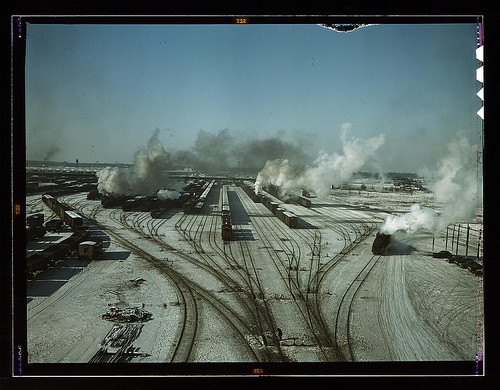
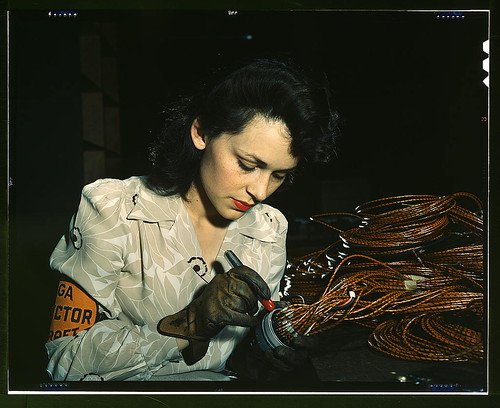
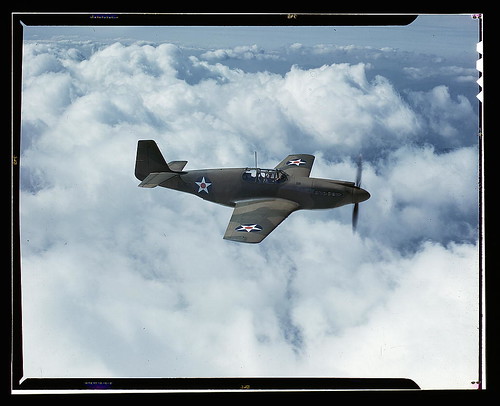
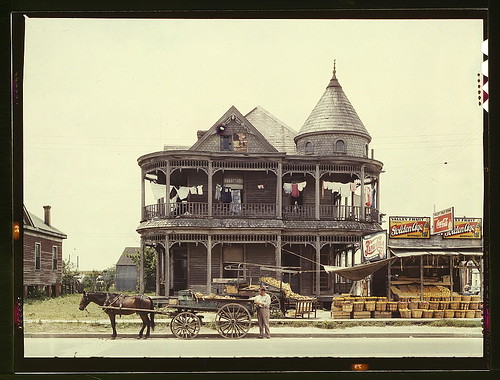
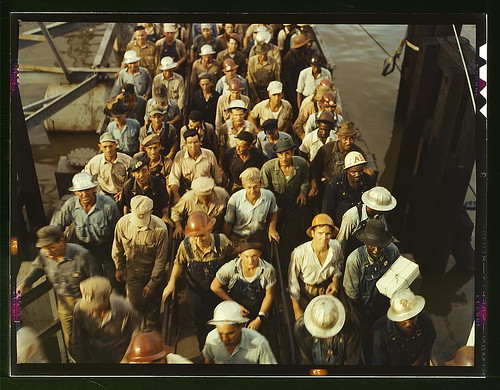
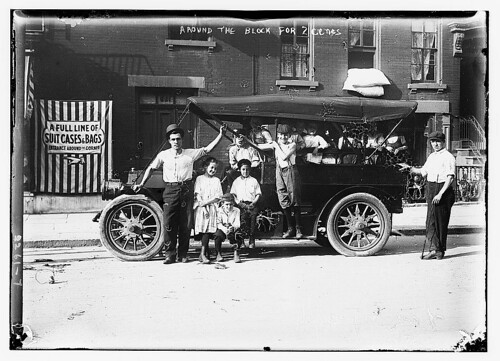
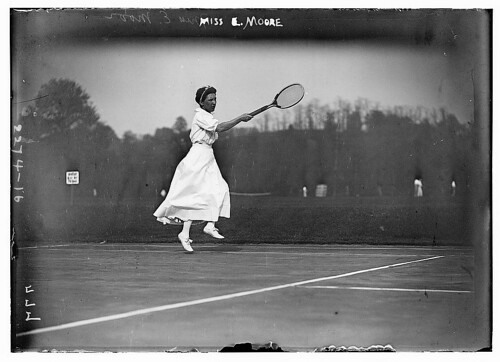
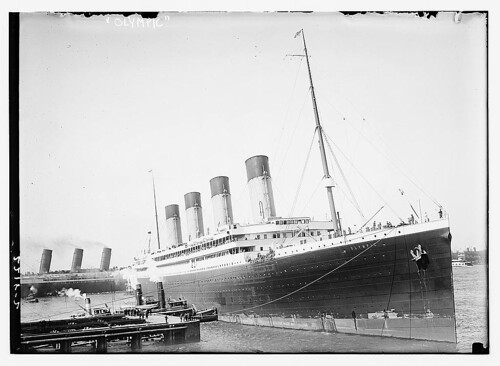
First up, Boing Boing has a story about the US Library of Congress publishing a bunch of copyright free historical photos on Flickr with the aim being to have people label them, which will be useful for the purposes of preservation. The photos, which are from the 1910s and the 1930s-40s, are fantastic and well preserved and definitely worth a gander. And remember, they're copyright free so anyone can use em!

Some samples (which are slightly cropped on the right side due to their width being larger than the damned column):


Delano, Jack,, 1914-, photographer.

General view of one of the classification yards of the Chicago and Northwestern Railroad, Chicago, Ill.

1942 Dec.


Bransby, David,, photographer.

Woman aircraft worker, Vega Aircraft Corporation, Burbank, Calif. Shown checking electrical assemblies

1942 June


Sherwood, Mark,, photographer.

North American's P-51 Mustang Fighter is in service with Britain's Royal Air Force, N[orth] A[merican] Aviation, Inc., Inglewood, Calif.

1942 Oct.


Vachon, John,, 1914-1975,, photographer.

House, Houston, Texas

1943 May


Vachon, John,, 1914-1975,, photographer.

Workers leaving Pennsylvania shipyards, Beaumont, Texas

1943 June


Bain News Service, publisher.

Around the block for 2 cents [car]

[between 1910 and 1915]


Bain News Service, publisher.

Miss Moore [tennis]

[between 1910 and 1915]


Bain News Service, publisher.

Olympic

[between 1910 and 1915]


Bain News Service, publisher.

Jap [sic] torpedo boat, driver ashore

[between 1910 and 1915]


Bain News Service, publisher.

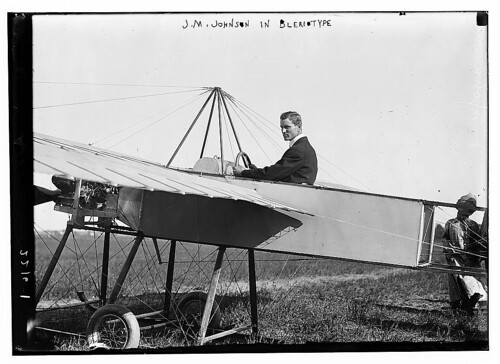
J.M. Johnson in Bleriotype [plane]

[between 1910 and 1915]


Not sure how long these have been available, but the 'Daily Bits' has a list of comics that are free or have freely available first issues. Some are online comics, others are downloadable files. I haven't had time to check 'em out yet - except for 'Fell #1' - but I'm looking forward to sampling the likes of 'Deadman', 'Y: The Last Man', 'Sandman', 'DMZ', 'Hellblazer', and 'Swamp Thing'.


And finally, Lawrence Lessig, founder of Creative Commons and advocate of reduced copyright restrictions, has released his 2001 book The Future of Ideas for free under a CC license. Naturally, I haven't read it yet, (and I'm not sure I want to read 300 pages of book on a screen), but it's probably worth a read. Once I finish the 50 or so other books I have waiting for me, that is.

Thursday, September 13, 2007

300 (2006)

300 (2006)

Madness? THIS... IS... SPARTA!

The trailers for '300' were simply amazing, perfectly crafted to be full of rousing spectacle and machismo, and the use of 'Just Like You Imagined' by Nine Inch Nails was inspired. It promised an original, visually spectacular, relentless action spectacular - and the final film delivers pretty much as advertised. Based on the comic by Frank Miller, '300' was directed by 'Dawn of the Dead' (2004 remake) helmer Zack Snyder, whose next project is the anticipated / dreaded adaptation of Alan Moore's Watchmen (haven't read it yet! [bows head in shame]). It is the second ultra stylized film, following 'Sin City', that replicates the visual style of its Frank Miller crafted source material.

The story is based on the historical Battle of Thermopylae that took place in the 5th Century BC between the Greeks led by Spartan King Leonidas (Gerard Butler) and the invading Persians led by King Xerxes I (Rodrigo Santoro). The plot is basic - Leonidas is forced to defend Sparta from an invading horde with only a small contingent of his army because the Spartan priests and oracle forbid war during an ongoing sacred festival. The Spartans, together with a few allies, block a narrow mountain pass and battle against the far superior numbers of the Persians, but suffer minimal losses thanks to their superior training and ability. Meanwhile, Leonidas' Queen Gorgo (Lena Headey) attempts to convince the Spartan council to send the army to back Leonidas.

It's no surprise how this story ends - it recounts arguably the most famous last stand in history - but the film isn't really too concerned with plot, apart from the stuff involving Queen Gorgo. Instead, its focus is more on theme, style, and visceral impact. The story is told as a flashback narrated by the only Spartan survivor of the battle, Dilios (David Wenham), who was sent away by Leonidas on the last day to spread the word on their heroic defense of Sparta. This narrative device naturally allows the film to take fantastical liberties and to embellish details.

A large part of the film focuses on building up the Spartans as a near mythical fighting force, demonstrating their complete and utter commitment to creating a nation of warriors who embrace combat in every aspect of their lives, both physical and mental. The Spartans are presented as a sort of idealized notion of mankind, being courageous and noble and loving freedom while also embodying physical perfection. The script enhances this mythic effect by having most of their lines be especially grand and stoic.

Once the milieu and characters established, the rest of the film concerns itself with style and action. The visuals are, as I said, highly stylized with a reddish-orange hue to everything and computer generated environments. These elements are very distinctive and memorable, and the film is very visually arresting, like a living painting. These visuals help to create a distorted world featuring fantastical elements - the Persians are depicted as having deformed mutants and massive beasts in their ranks, and Xerxes himself is a veritable giant.

The action on display is stunning and features incredibly violent and dynamic sequences that cut between slow-mo and ultra-fast repeatedly within long continuous takes, stuff that certainly hasn't been seen before. Snyder prevents the action from becoming stale by frequently changing the adversaries that the Persians throw at the embattled Spartans, and although it still does occasionally feel a little repetitive, the brutal impact of the clashes never really diminishes, right up to the Spartans last stand. The secondary story focusing on Gorgo is less gripping and dabbles with a few political elements that attempt to add some substance and weight to the story. These scenes work to give a breather between the battles, but ultimately go nowhere and only serve to send ambiguous political messages.

There's one performance in this film to write home about, and that's Gerard Butler's. His filmography shows nothing impressive before '300' as far as I can tell, so his work in this comes as quite a surprise, though there were certainly signs of a good performance in the trailers. Butler's Leonidas is imposing and commands attention whenever he's on screen, and it's easy to believe that he inspires the devotion of his men. He's fearless, brash and belligerent, but he's also contemplative and burdened by his responsibility to Sparta.

And then there's the physicality. This applies to all of the guys playing the Spartans; their commitment to the roles in terms of their physical appearance is almost worthy of the characters that they're playing. These guys look and move like the greatest warriors on the planet, and are absolutely convincing. David Wenham and Lena Headey are alright in their roles, with Wenham's narration being quite good even if it does intrude on proceedings a little too often. An honourable mention for Rodrigo Santoro, whose Xerxes is menacing and downright creepy.

'300' is a unique cinematic experience, one that probably won't be to everyone's taste thanks to its proclivity for copious bloodletting, nudity, and graphic sex. For those less sensitive souls it represents an entertaining and engrossing action fest, full of visual splendour and thrilling battle sequences (even if they don't always feel as epic as other recent medieval battle scenes). I expected to be entertained, and I was, and doubtless will be again when I revisit the film.

Tuesday, May 08, 2007

Kingdom of Heaven - Director's Cut (2005)

Kingdom of Heaven - Director's Cut (2005)
Be without fear in the face of your enemies. Be brave and upright that God may love thee. Speak the truth always, even if it leads to your death. Safeguard the helpless and do no wrong. That is your oath.

I first saw Ridley Scott's Crusades epic shortly after it first came out back in 2005 and came away somewhat underwhelmed. While I felt that it was a good movie, it was lacking in many ways - characterization and plot elements were a little sketchy. Unsurprisingly, it turned out that the studio had chopped off lots of the film to make it shorter and more palatable for general audiences. Fortunately, Ridley Scott was provided the opportunity to release his definitive version of the film on DVD, and while I wouldn't call it a masterpiece it's much, much better than the theatrical cut.

Kingdom of Heaven focuses on several characters, but the protagonist is Balian (Orlando Bloom), who is introduced as a blacksmith mourning his wife; she committed suicide after the death of their child. Godfrey Baron of Ibelin (Liam Neeson), a lord from the Holy Lands, arrives in Balian's village and claims Balian as his son (out of wedlock) and rightful heir, and asks him to accompany him back. Balian, who is unwelcome in his village, initially refuses but later commits murder in a fit of rage and joins up with Godfrey and his accompanying Knights with the hope of finding spiritual redemption in Jerusalem. Their party is attacked by men who arrive to arrest Balian, and Godfrey is mortally wounded during the struggle. He Knights Balian and bequeaths the Barony of Ibelin to him. Balian then makes the treacherous journey to Jerusalem, nearly losing his life twice in the process.

The second act of the film introduces the key players and the politics of Jerusalem. Balian finds Ibelin to be dry and barren, and sets to work trying to improve it. He finds the Kingdom divided - King Baldwin (Ed Norton) and Lord Tiberias (Jeremy Irons) struggle to maintain peace between the Christians occupying Jerusalem and the ever growing power of the Muslims led by Salahuddin (Ghassan Massoud), while Guy of Lusignan (Marton Csokas) and Raynald of Châtillon (Brendan Gleeson) try to instigate war against them in the belief that it is 'God's will' for the Christians to prevail (ironically, the hardliners in Salahuddin's camp believe it is 'God's will' for the Muslims to prevail). Guy is married to King Baldwin's sister Sibylla (Eva Green), who has an affair with Balian. Further complicating matters is the fact that King Baldwin is dying as a result of his leprosy, leaving the fate of the Kingdom in the hands of whomever succeeds him. The third act of the film revolves around the battle to defend Jerusalem, with the defenders being led by Balian.

Almost all of what I've described applies to both cuts of the film, but the Director's Cut adds a lot of depth to it, and elevates it from a good one to an excellent one. Backstory, characterization, and one significant subplot are added to the film, which makes it far more complete. 'Kingdom of Heaven' is rich in plot, character, and themes. The story is laced with elements of politics, religion, fanaticism, courage, and honour. The character of Balian is used to some extent as a focal point around which all the other elements of the film revolve - we see mostly from his point of view, and his presence influences those around him. William Monahan's screenplay balances and interweaves the various elements of plot and character into a compelling whole that provides a window into a bygone era. It may not be historically accurate in terms of people and events, and some concepts (such as some character viewpoints) may seem a little too modern to be believable, but taken as a whole the film has an air of verisimilitude about it. The characters are compelling and complex, and unlike in Scott's 'Gladiator' (which I think is a brilliant revenge / action film that had no need for an 'Extended Cut') there's some ambiguity to them.

Balian is a noble and virtuous (to a fault) knight who seeks redemption in the Holy Land and is reluctant to involve himself in the political games of the aristocracy, but he's not squeaky clean - he has blood on his hands and engages in adultery. Orlando Bloom is not the most magnetic leading man, but he's effective in this film because the character is so low key and idealistic, a demeanour perfectly suited to Bloom. He doesn't have to carry the film until the last act where he leads the defence of Jerusalem, which is the only point where his performance doesn't deliver. Godfrey, Balian's father, is a character who hopes to bring some meaning to his weary and bloody life when he brings Balian with him to be his successor, and is willing to break the law to have Balian by his side. Liam Neeson can do the noble mentor figure any day, and he's great as always in this.

King Baldwin is a young but wise ruler who realizes that he maintains an uneasy peace, and is willing to compromise personal honour to maintain it. Edward Norton is barely recognizable and brilliant as the Leper King - he exudes authority and intelligence despite being hidden behind a metal mask. Equally great is Ghassan Massoud as Salahuddin, a brilliant military leader caught between his honour and respect for King Baldwin and his promise to liberate Jerusalem. Massoud is incredibly charismatic and commanding in the role, and the scene where the two Kings meet face to face is a brief but memorable one. Sibylla is a headstrong woman whose relationship with Balian is understandable; she's later thrust into an unenviable position when she becomes Queen, and has to deal with a personal tragedy relating to her son. Eva Green is terrific in the role, going through a transformation in the film and ending up a shattered individual (as an aside, Eva Green has the most endearing 'permanent frown' expression I've ever seen).

The one disappointing portrayal is Marton Csokas as Guy, who is a little over the top in his evil ways, though the script doesn't really give him anything non-evil to do. There are many supporting characters as well - Brendan Gleeson is over the top but clearly playing an insane man in Raynald of Châtillon, David Thewlis is memorable as the pragmatic Hospitaler, and Alexander Siddig is surprisingly commanding as Nasir (a far cry from Doctor Bashir!).

As one would expect from a Ridley Scott film, the visuals are stunning and the action sequences chaotic. There's a lot in the film that is reminiscent of 'The Return of the King', including the siege of Jerusalem, although the action never quite gets to that level of excitement and insanity! As with Gladiator, there are moody contemplative moments for the protagonist, emotions and sentiments are often worn on the sleeve, and the petulant villains sneer, scowl, and glower at every opportunity. The music from Harry Gregson-Williams is complementary and appropriate, if unmemorable. The production values are, unsurprisingly, fantastic and virtually flawless, as are the special effects, which true to form are not used in an overly showy manner by Scott.

This post ended up being longer than I initially intended; I guess the film required a bit more consideration than anticipated. It's excellent and is the only version of 'Kingdom of Heaven' that needs to be seen. Clocking in at over three hours (50 minutes longer than the original cut), it's an epic in every way, and a memorable one. Well worth watching, especially for people who felt the theatrical version was a decent film that could have been better.

Thursday, March 15, 2007

His Majesty's Dragon by Naomi Novik (2006)

His Majesty's Dragon by Naomi Novik (2006)

I bought this book on a whim, and I blame Peter Jackson, the guy who directed The Lord of the Rings films. See, last year it was announced that he had acquired the rights to the film adaptations of the Temeraire series of books by Naomi Novik, the first of which is His Majesty's Dragon. When the guy who made some of the best and most spectacular films in recent memory picks source material for his future films, I pay attention. I saw this while scanning the shelves of a bookshop and bought it on impulse. After all, who can say no to the heartwarming tale of a man and his dragon? (I'm in bad pun mode these days) Sadly, the first in the Temeraire series doesn't come even remotely close to Tolkien's classic, doorstop sized tome.

His Majesty's Dragon is set during the Napoleonic Wars, towards the end of the 18th Century. Only, it's the 18th Century Jim, but not as we know it. It's an alternate history where dragons exist, and are used in combat like aerial warships, complete with full blown crews. Captain Will Laurence, commander of a British Naval warship, takes a French ship as a prize. On board the ship is a dragon egg that's about to hatch. Unfortunately for Laurence, a dragon must be 'harnessed' and assigned an aviator as soon as it hatches, otherwise it ends up becoming feral. Being too far out from a friendly port to hand over the egg to the Aerial Corps before it hatches, Laurence ends up becoming the dragon's aviator. Dragons are born with the ability to speak - they learn through the shell - and when the hatchling asks what his name is, Laurence christens him Temeraire. An aviator is assigned to a dragon for life, so Laurence effectively gives up his promising naval career and all hope of a normal life in the name of duty; the British Aerial Corps is desperate for more dragons in the face of Bonaparte's superior forces. The secretive Corps is generally ostracized, and Laurence's new position puts him in a quagmire, as he becomes an outcast in his own society and the Corps, who are resentful towards him. What follows is the story of how Laurence and Temeraire (who turns out to be a rare and exotic breed of dragon that is more intelligent than most) bond as friends, train to become full blown members of the Aerial Corps, and do their utmost in the name of their country.

I quite like the premise of the book, and the story is a fair introduction into this faux history featuring dragons, aviators, and aerial combat. The best things in the book are the allusions to the war and how they relate to and deviate from real history, the workings of the Aerial Corps and how it integrates into 18th century society, and finally aerial dragon combat. When the book jumps into dragon battle mode, it's fairly engaging. Unfortunately, everything else is weak. The characters are two dimensional and clichéd - Laurence is noble, dignified, brave, and an all round incredible officer who cares deeply for his dragon, and gets all righteous at even the slightest criticism. Every other character has even less depth and complexity than him, and every conversation is stiff and formal and wooden. This manner of speech may be historically accurate, but that doesn't excuse the fact that virtually every conversation feels decidedly inhuman. Ironically, the most human character is Temeraire, who actually has a wee bit of depth. The downside is that he and all the other dragons behave like infants. They're needy, spend a lot of time sleeping, drool food all over themselves and need constant cleaning, and interact with each other with all the maturity of toddlers. While I suppose this is just as valid an interpretation as any other, I found it really... well, lame. I like my dragons as vicious beasts or wise and condescending bastards, not prima donnas. Also, the lovey-dovey stuff between Laurence and Temeraire is just... ugh... with 'my dear' this and 'my dear' that, you sometimes wish they'd get a room.

The story also has many repetitive beats. Laurence has trouble fitting in, and must act stoic and gentlemanly while earning someone's respect. Laurence has to console and take care of Temeraire, who regularly has mood swings. Laurence and Temeraire train hard, impress everyone, and prove themselves. Much of this stuff feels clumsy and simplistic. Even the big twist and the surprise during the final battle are telegraphed a mile away. There's also a lack of atmosphere and sense of place, with very little in the way of description. I think a lot of my understanding of the milieu of the book came from what I already knew, and not really from the book itself.

His Majesty's Dragon isn't an awful book; far from it. I can imagine liking this as a teenager, but right now I'm a little more discerning, and mediocre just doesn't cut it. It's an interesting premise and a fair introductory story to a series, but it's not particularly well executed. There's some cool stuff, and a few exciting moments. I can see a lot of scope for a cinematic adaptation, especially the aerial combat, but the characters will have to be given more depth - even the more minor characters in Lord of the Rings had more to them than the major ones in this. Jackson is a guy who brings verisimilitude and character to his spectacular films, so as long as it isn't overlong like King Kong, I'd be interested in watching the rest of the series as films even though I won't be reading them.