Richard Feynman was one of the most famous physicists of the twentieth century - a bona fide genius and, if this book is anything to go by, a fun guy!
Surely You're Joking, Mr. Feynman! is in essence a transcript of taped anecdotal conversations he had with his friend Ralph Leighton. It covers Feynman's life from childhood and college through the Manhattan Project, his winning of the Nobel Prize in the mid sixties, and beyond.
Given the nature of the source material for the book, it should come as no surprise that it has a very laid back and talky style. Feynman vividly recollects and recounts various incidents, people, and ideas from his life. This covers a broad spectrum that includes his time at various universities and a lengthy section on Palo Alto. He describes his work in biology and passion for languages and music, for tinkering (he became something of a safecracker at one point!), and his late success as a painter.
Despite his obvious brilliance he never comes across as condescending or arrogant. He makes frank (often blunt) and insightful comments about people, institutions, society, and ideologies, all in a very accessible and engaging manner, and often punctuated with humour. He was also a bit of a ladies' man and he speaks with the same enthusiasm about his encounters with the opposite sex as he does when talking about physics. Speaking of physics, there are bits in here that may be too esoteric and inaccessible for the average reader, but these are few and far between and certainly don't derail the book.
The disjointed nature of the book makes it more a collection of short stories than a continuous progression, but they are all bound together by Feynman's unmistakable voice. While few people can possibly hope to achieve even a small fraction of what he did, they surely can't fail to be inspired by his unbridled curiosity and love of life, and by how his intellect was checked by modesty and humility. It's a fascinating look into the mind of a genius!
Showing posts with label books. Show all posts
Showing posts with label books. Show all posts
Tuesday, July 19, 2011

Sunday, July 17, 2011
The Fountainhead - Ayn Rand
I didn't actually finish reading The Fountainhead. After enduring one third of this appalling book I simply gave up. This is not because of my thoughts on Rand's self centred philosophy (I wouldn't have bothered starting it if that were the case, plus there are aspects of this philosophy that I subscribe to), but rather to do with the fact that it is poorly written, overlong to the point that calling it bloated would be an understatement, repetitive, one note both tonally and in a narrative sense, and features bland, self important, one dimensional characters.
There are many things in the world that I don't like that other people do. In most of these cases, however, I can understand the appeal - at least to some extent. This leaves me with one question about this novel (and presumably Atlas Shrugged) - what on earth do its fans see in it? What is there in this novel that is of value, that makes it worth reading, apart from the fact that it is famous (not a good reason at all). Perhaps reading it to its conclusion would enlighten me, but a quick read of the synopsis on Wikipedia suggests that the final two-thirds are as much an exercise in endurance as the first.
I can only imagine that the theme of unappreciated genius that perseveres in the face of an apathetic and sometimes downright hostile society holds some appeal to people, but in the case of this book that theme is presented with such precious little subtlety and with such an excess of childish simplicity that this theory seems unlikely; still, it's all I've got!
This marks my first and last foray into the writings of Ayn Rand.
There are many things in the world that I don't like that other people do. In most of these cases, however, I can understand the appeal - at least to some extent. This leaves me with one question about this novel (and presumably Atlas Shrugged) - what on earth do its fans see in it? What is there in this novel that is of value, that makes it worth reading, apart from the fact that it is famous (not a good reason at all). Perhaps reading it to its conclusion would enlighten me, but a quick read of the synopsis on Wikipedia suggests that the final two-thirds are as much an exercise in endurance as the first.
I can only imagine that the theme of unappreciated genius that perseveres in the face of an apathetic and sometimes downright hostile society holds some appeal to people, but in the case of this book that theme is presented with such precious little subtlety and with such an excess of childish simplicity that this theory seems unlikely; still, it's all I've got!
This marks my first and last foray into the writings of Ayn Rand.
Saturday, May 10, 2008
A Fall of Moondust (1961) by Arthur C. Clarke

(Image from Wikipedia)

A Fall of Moondust (1961) by Arthur C. Clarke
Arthur C. Clarke, one of the grand masters of science fiction, passed away recently but he left behind a legacy that comprises a significant number of works. I've read a fair number of them but it's been a while, so I intend to revisit his most significant efforts sometime soon. 'A Fall of Moondust' is actually one that I'd never read before. It's basically a disaster story set on the moon involving a tourist 'boat' that travels on a 'sea' of sand; a lunar quake causes the boat to be buried under the sand with only days of life support left. The plot revolves around the rescue efforts by the engineers on the moon and the efforts of the trapped passengers to try and stay alive and keep their hopes up.
Clarke was never one for writing great characters, and this book is particularly weak when it comes to the human side of things, with sketchy and cliched characterization and mechanical behaviour. But reading Clarke for the characters is like reading Mills & Boon for the technology - it's misguided in the extreme. What he was a master of was creating interesting and believable future scenarios grounded in (extrapolated) science, scenarios full of keenly observed details regarding both technology and its impact on society. He also typically managed to create a narrative within the scenario that featured science (mainly physics) in a big way.
This book is no different - at every turn Clarke throws out little nuggets of physics and technology and brief asides on what this future world and society is like and why it is that way. Sometimes though it can all sound a little too didactic, almost like he wrote the book more to convey his ideas and conjured up a loose narrative out of necessity, but more often than not the two aspects complement each other nicely. As the search and rescue operation gets underway, we are treated to discourse on space travel, communication, the moon and lunar life, the problems of reduced gravity, the media, and so on. For me and other geeks like me the subject matter is utterly intriguing.
While I complained about the characters, their behaviour from a story point of view is actually quite convincing - it's the way they're written, the dialogue and the clunkiness of their personality that is weak - which makes for an interesting human aspect as the passengers, a quite motley crew, try to while away the time without losing control of the situation. There's a terrific sense of pacing in the book, it really is well structured and very cinematic with bouts of excitement and despair being introduced at regular intervals, and the whole story culminating in a thrilling race against time.
In the end there's nothing particularly brilliant about the book, but as a 'what if' scenario it is fascinating. Clarke's style is basic but the strength of the ideas and his descriptiveness are enough to make this a real page turner, and the flaws fall by the wayside as you are hurtled towards the conclusion. Perhaps not the best of his works, but a good read nonetheless.
Thursday, April 24, 2008
Animal Farm (1945) - by George Orwell
Animal Farm (1945) - by George Orwell
I first read Orwell's brilliant novella in school, and it's one of those resonant stories that stayed with me over the years, particularly because I began to recognise the elements of the real world that had been incorporated into it. Ostensibly it tells the story of a group of animals on a farm who become fed up of being subservient to their human masters and revolt. They set up a utopian socialist society where the animals are free and share in the farm's wealth. Everything is rosy at first, but things slowly start to change as the pigs, their de facto leaders, slowly and insidiously change the rules in their favour, accumulating wealth and power at the expense of the other animals.
The story is short, running at less than a hundred pages, and is very straightforward in its telling; as an allegory of the Soviet Union under Stalin, it's thinly veiled. Its elegance comes from its simple, matter of fact prose and from the fact that what it describes is completely true. The inexorable shift in the balance of power and the disingenuous justifications, hollow rhetoric, and threat of force that the pigs use to keep the rest in check are all the hallmarks of tyrants that have been witnessed in the real world throughout history.
If the pigs represent the ruling classes in the microcosm of society that is Animal Farm, the other animals represent the other social groups within that society, from the hard working, unquestioningly loyal simpletons to the blind, loud, and devout sheep-like followers (literally sheep in the story), to the intelligent but indifferent or powerless. At every stage the pigs have a strategy to explain their actions and to silence the critics, and over time the animals' lives become miserable. But as their misery becomes the status quo, many continue to believe the lie that life is better simply because they are free of the tyrannical humans, being completely oblivious to the fact that they have traded in one master for another.
Ultimately, the book chronicles the way in which a revolution with the best of intentions and beginnings can be subverted by totalitarianism and fascism and leave the people (err, animals) even worse off than before, and it demonstrates convincingly how those in power get away with it. Despite being superficially simple, the book really whittles down these societal realities to their core. It doesn't have much in the way of plot or characters, nor does it need to; built purely on ideas, 'Animal Farm' is a quick and unforgettable read and an absolute classic.
I first read Orwell's brilliant novella in school, and it's one of those resonant stories that stayed with me over the years, particularly because I began to recognise the elements of the real world that had been incorporated into it. Ostensibly it tells the story of a group of animals on a farm who become fed up of being subservient to their human masters and revolt. They set up a utopian socialist society where the animals are free and share in the farm's wealth. Everything is rosy at first, but things slowly start to change as the pigs, their de facto leaders, slowly and insidiously change the rules in their favour, accumulating wealth and power at the expense of the other animals.
The story is short, running at less than a hundred pages, and is very straightforward in its telling; as an allegory of the Soviet Union under Stalin, it's thinly veiled. Its elegance comes from its simple, matter of fact prose and from the fact that what it describes is completely true. The inexorable shift in the balance of power and the disingenuous justifications, hollow rhetoric, and threat of force that the pigs use to keep the rest in check are all the hallmarks of tyrants that have been witnessed in the real world throughout history.
If the pigs represent the ruling classes in the microcosm of society that is Animal Farm, the other animals represent the other social groups within that society, from the hard working, unquestioningly loyal simpletons to the blind, loud, and devout sheep-like followers (literally sheep in the story), to the intelligent but indifferent or powerless. At every stage the pigs have a strategy to explain their actions and to silence the critics, and over time the animals' lives become miserable. But as their misery becomes the status quo, many continue to believe the lie that life is better simply because they are free of the tyrannical humans, being completely oblivious to the fact that they have traded in one master for another.
Ultimately, the book chronicles the way in which a revolution with the best of intentions and beginnings can be subverted by totalitarianism and fascism and leave the people (err, animals) even worse off than before, and it demonstrates convincingly how those in power get away with it. Despite being superficially simple, the book really whittles down these societal realities to their core. It doesn't have much in the way of plot or characters, nor does it need to; built purely on ideas, 'Animal Farm' is a quick and unforgettable read and an absolute classic.
Monday, January 28, 2008
No Country for Old Men (2005) by Cormac McCarthy

No Country for Old Men (2005) by Cormac McCarthy
Another novel recently made into a film that I've managed to read first. Unlike 'I Am Legend' though, this book's adaptation looks (and apparently is) very, very faithful to the source material, so much so that nigh on every line in the trailer seemed to the best of my recollection to be lifted verbatim from Cormac McCarthy's novel. Which is a good thing because the novel is propulsive and cinematic, and the story and subject matter seem to be suitable for the sensibilities of the guys who made Fargo.
'No Country for Old Men' is a bleak western thriller set in Texas in the early eighties that follows the criss crossing paths of three men. It begins with Llewellyn Moss, a relatively poor chap who works as a welder, coming across a drug deal gone bad in the middle of the desert. He comes across a bag full of money and makes the life changing decision to take it, knowing full well that it could be the end of him; he follows this choice with a really bad one that causes him to end up on the run. Anton Chigurh is an assassin / problem solver working for the drug buyers who comes looking for the money and picks up Moss's trail. Chigurh is a relentless and amoral being, a man of pure evil who believes himself to be merely an implement in a world of cause and effect, and he leaves a trail of corpses behind him in his quest. Sheriff Ed Tom Bell is the man who has to deal with the aftermath of Chigurh as he tries to get to Moss first and save him, and also end the spate of killings.
The book is framed at the start of each chapter by ruminations from Sheriff Bell, who recounts his past and his thoughts on the country and how much it has changed for the worse. The main narrative jumps back and forth between the three protagonists as events unfold, with the consequences of those events being depicted from different perspectives. A word about the style of the book - it's quite unconventional and feels very abrupt. I mean that in a good way, as McCarthy really does (as the blurbs promise!) convey a great deal using few words, and creates a strong sense of place and character. The dialogue is superb; it's just sharp and to the point, full of curt exchanges and philosophical ruminations. It's also often quite hilarious. The style in which it is written makes it seem impossible for it to be read in anything but a 'Southern' accent, almost as if the accent is purely dictated by the style of speech.
Although it doesn't dwell much on backstory, the characters come to life vividly through their actions and speech. It's a non stop thrill ride that is hard to put down, and it features quite a few tense 'action' sequences and violent shootouts. Like I said, very cinematic. Though it also sometimes throws you for a loop by having things happen 'offscreen' where the reader is only entitled to the aftermath and is left to fill in the blanks. Which is very doable, even though I will confess a few plot points ended up eluding me. While a thriller on the surface, the book acts as a commentary on morality, the degradation of values in society, and the prevalence of evil and violence in the world, with the latter being embodied to great effect by the frightening Chigurgh. The character of Chigurgh is almost like a human terminator, relentless and unstoppable and impossible to bargain with; a force of nature.
'No Country for Old Men' is a terrific book, downbeat but compulsive and a fairly quick read that makes quite an impression. I don't necessarily fully agree with the sentiments expressed by the character of Bell (presumably they echo those of McCarthy), but I can see where they're coming from and a lot of what he says about society and the world are true; while I don't think people have necessarily become worse per se, modern society does facilitate base behaviour on a larger scale than it once did. In the midst of being thrilled and amused, the book leaves you with something to chew on and doesn't really offer a ray of sunshine at the end to make you feel better about the world. But don't let the pessimism put you off, as reading this book is worth your while.
Saturday, January 19, 2008
Cool stuff for free on the Interweb
First up, Boing Boing has a story about the US Library of Congress publishing a bunch of copyright free historical photos on Flickr with the aim being to have people label them, which will be useful for the purposes of preservation. The photos, which are from the 1910s and the 1930s-40s, are fantastic and well preserved and definitely worth a gander. And remember, they're copyright free so anyone can use em!
Some samples (which are slightly cropped on the right side due to their width being larger than the damned column):

Delano, Jack,, 1914-, photographer.
General view of one of the classification yards of the Chicago and Northwestern Railroad, Chicago, Ill.
1942 Dec.

Bransby, David,, photographer.
Woman aircraft worker, Vega Aircraft Corporation, Burbank, Calif. Shown checking electrical assemblies
1942 June

Sherwood, Mark,, photographer.
North American's P-51 Mustang Fighter is in service with Britain's Royal Air Force, N[orth] A[merican] Aviation, Inc., Inglewood, Calif.
1942 Oct.

Vachon, John,, 1914-1975,, photographer.
House, Houston, Texas
1943 May

Vachon, John,, 1914-1975,, photographer.
Workers leaving Pennsylvania shipyards, Beaumont, Texas
1943 June

Bain News Service, publisher.
Around the block for 2 cents [car]
[between 1910 and 1915]

Bain News Service, publisher.
Miss Moore [tennis]
[between 1910 and 1915]

Bain News Service, publisher.
Olympic
[between 1910 and 1915]

Bain News Service, publisher.
Jap [sic] torpedo boat, driver ashore
[between 1910 and 1915]

Bain News Service, publisher.
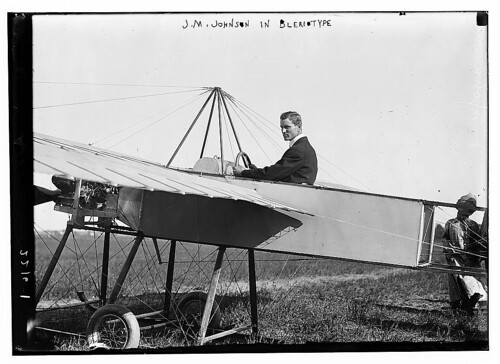
J.M. Johnson in Bleriotype [plane]
[between 1910 and 1915]
Not sure how long these have been available, but the 'Daily Bits' has a list of comics that are free or have freely available first issues. Some are online comics, others are downloadable files. I haven't had time to check 'em out yet - except for 'Fell #1' - but I'm looking forward to sampling the likes of 'Deadman', 'Y: The Last Man', 'Sandman', 'DMZ', 'Hellblazer', and 'Swamp Thing'.
And finally, Lawrence Lessig, founder of Creative Commons and advocate of reduced copyright restrictions, has released his 2001 book The Future of Ideas for free under a CC license. Naturally, I haven't read it yet, (and I'm not sure I want to read 300 pages of book on a screen), but it's probably worth a read. Once I finish the 50 or so other books I have waiting for me, that is.
Some samples (which are slightly cropped on the right side due to their width being larger than the damned column):
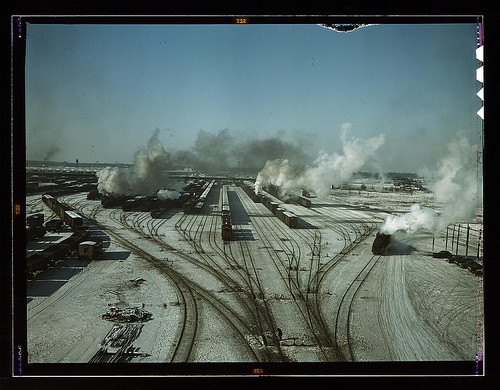
Delano, Jack,, 1914-, photographer.
General view of one of the classification yards of the Chicago and Northwestern Railroad, Chicago, Ill.
1942 Dec.
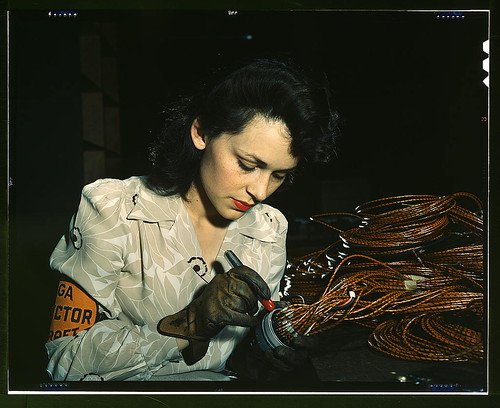
Bransby, David,, photographer.
Woman aircraft worker, Vega Aircraft Corporation, Burbank, Calif. Shown checking electrical assemblies
1942 June
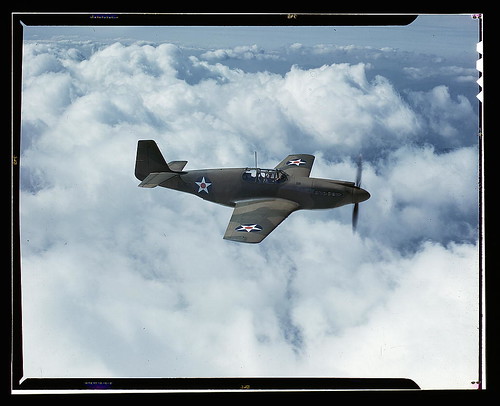
Sherwood, Mark,, photographer.
North American's P-51 Mustang Fighter is in service with Britain's Royal Air Force, N[orth] A[merican] Aviation, Inc., Inglewood, Calif.
1942 Oct.
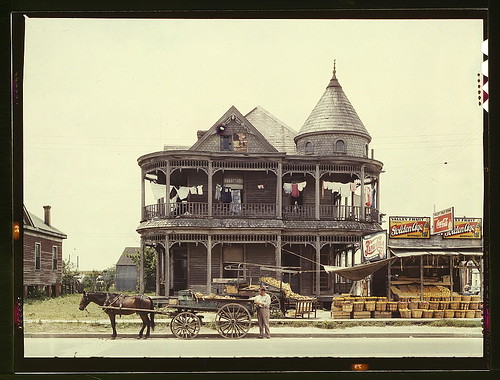
Vachon, John,, 1914-1975,, photographer.
House, Houston, Texas
1943 May
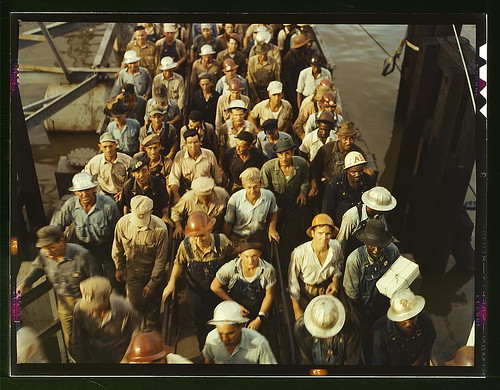
Vachon, John,, 1914-1975,, photographer.
Workers leaving Pennsylvania shipyards, Beaumont, Texas
1943 June
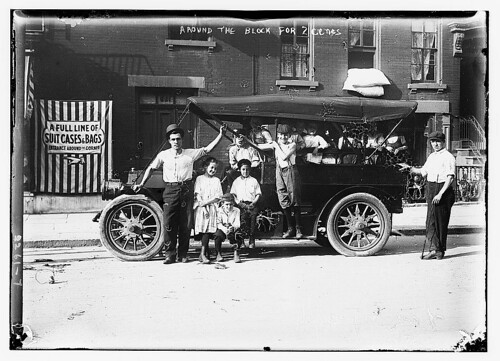
Bain News Service, publisher.
Around the block for 2 cents [car]
[between 1910 and 1915]

Bain News Service, publisher.
Miss Moore [tennis]
[between 1910 and 1915]
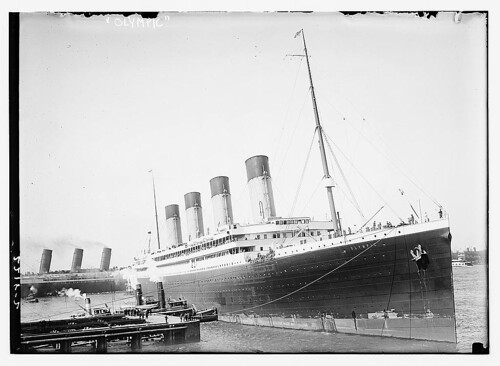
Bain News Service, publisher.
Olympic
[between 1910 and 1915]
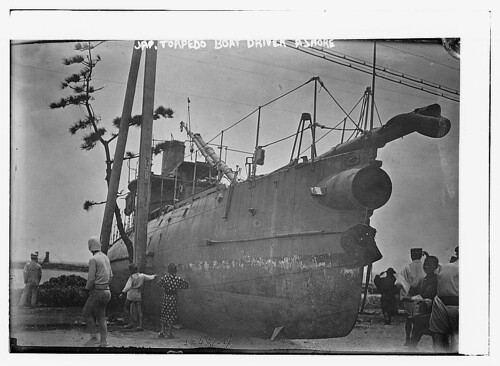
Bain News Service, publisher.
Jap [sic] torpedo boat, driver ashore
[between 1910 and 1915]
Bain News Service, publisher.
J.M. Johnson in Bleriotype [plane]
[between 1910 and 1915]
Not sure how long these have been available, but the 'Daily Bits' has a list of comics that are free or have freely available first issues. Some are online comics, others are downloadable files. I haven't had time to check 'em out yet - except for 'Fell #1' - but I'm looking forward to sampling the likes of 'Deadman', 'Y: The Last Man', 'Sandman', 'DMZ', 'Hellblazer', and 'Swamp Thing'.
And finally, Lawrence Lessig, founder of Creative Commons and advocate of reduced copyright restrictions, has released his 2001 book The Future of Ideas for free under a CC license. Naturally, I haven't read it yet, (and I'm not sure I want to read 300 pages of book on a screen), but it's probably worth a read. Once I finish the 50 or so other books I have waiting for me, that is.
Thursday, January 10, 2008
I Am Legend (1954) by Richard Matheson
I Am Legend (1954) by Richard Matheson
'I Am Legend' is a title that is in people's collective consciousness right now thanks to the new Will Smith film, which is actually the third cinematic adaptation of Richard Matheson's seminal classic. Having just finished reading the book, I'm not surprised there have been so many attempts - the source material is quite phenomenal.
Robert Neville is the novel's protagonist, seemingly the last survivor of a plague, the last man on Earth. This plague has caused the dead to come back from the grave (this book was, unsurprisingly, hugely influential on the zombie genre) as blood sucking vampires, and those infected who haven't died yet are similarly afflicted with a taste for blood. Neville lives alone in his fortified house that is boarded up and lined with garlic and equipped with a generator and a massive freezer full of food to sustain him. And yes, these vampires exhibit all of the legendary traits of vampirism - drinking blood, inability to come out in sunlight, fear of garlic, death from stakes through the heart, and fear of the cross are all present.
The story chronicles Neville's existence as the last bastion of civilization. By day the vampires enter a comatose state leaving him free to roam the town at will, and he uses this time to get whatever supplies he needs, to carefully maintain his house's defenses, and to hunt down and kill as many of the vampires as he can before sundown, which is when they awaken. Refusing to accept a supernatural explanation, he also dedicates himself to study and research to try and determine the nature of vampirism and how it wiped out mankind, and to possibly come up with a cure for the infected still left alive.
Matheson explores the way loneliness and hopelessness tear away at Neville's psyche, with the character swinging into bouts of drunken depression on many an occasion (I lost count of how many bottles and glasses he smashes). Neville isn't exactly a superman; while he is extremely resourceful he has had his fair share of luck (being immune to the infection, for one), and the situation and his own volatile nature take their toll, causing him to have near brushes with death due to the smallest of lapses in his careful routine. The character is written as multi-dimensional and believable, and Matheson allows us into his thoughts (there is obviously not much in the way of conversation in this book), which makes his experiences all the more sympathetic and emotional. The recounting of Neville's oppressive existence is broken up by poignant flashbacks into the early days of the plague, when his wife was still alive and society was still functioning.
Apart from Neville's personal struggle and his memories, the book goes into some detail on how he manages to survive through careful routine. It also goes to great lengths (via Neville's ruminations) theorizing about the biology of vampires and about their place in history. Neville's research into the plague and what causes the symptoms of vampirism are suitably well explained and seem logical, at least at a layman's level. And while for much of the time Neville seems reasonably safe and adept at surviving, there are a few moments in the book, particularly one in which he fails to get home before sunset, that are infused with sheer terror and are incredibly exciting. The book yanks you into the tale from the opening pages and never really lets go once you enter Neville's terrifying world. Its different story threads are balanced in a manner where they all build up and coalesce to make the surprising twist of the last few chapters fully earned and completely satisfying.
'I Am Legend' is a gripping tale that is convincing in its depiction of one man's tragic struggle in a post apocalyptic world. It is a moving look into isolation and despair, while also a thought provoking commentary on history and legends, society, morality, and humanity in general, all wrapped together in a layer of science and logical thought and interspersed with helpings of excitement and terror. Matheson doesn't set a foot wrong and ends the book on a perfect note, one that explains the title of the book. I can't recommend this one enough, it's a genuine classic!
'I Am Legend' is a title that is in people's collective consciousness right now thanks to the new Will Smith film, which is actually the third cinematic adaptation of Richard Matheson's seminal classic. Having just finished reading the book, I'm not surprised there have been so many attempts - the source material is quite phenomenal.
Robert Neville is the novel's protagonist, seemingly the last survivor of a plague, the last man on Earth. This plague has caused the dead to come back from the grave (this book was, unsurprisingly, hugely influential on the zombie genre) as blood sucking vampires, and those infected who haven't died yet are similarly afflicted with a taste for blood. Neville lives alone in his fortified house that is boarded up and lined with garlic and equipped with a generator and a massive freezer full of food to sustain him. And yes, these vampires exhibit all of the legendary traits of vampirism - drinking blood, inability to come out in sunlight, fear of garlic, death from stakes through the heart, and fear of the cross are all present.
The story chronicles Neville's existence as the last bastion of civilization. By day the vampires enter a comatose state leaving him free to roam the town at will, and he uses this time to get whatever supplies he needs, to carefully maintain his house's defenses, and to hunt down and kill as many of the vampires as he can before sundown, which is when they awaken. Refusing to accept a supernatural explanation, he also dedicates himself to study and research to try and determine the nature of vampirism and how it wiped out mankind, and to possibly come up with a cure for the infected still left alive.
Matheson explores the way loneliness and hopelessness tear away at Neville's psyche, with the character swinging into bouts of drunken depression on many an occasion (I lost count of how many bottles and glasses he smashes). Neville isn't exactly a superman; while he is extremely resourceful he has had his fair share of luck (being immune to the infection, for one), and the situation and his own volatile nature take their toll, causing him to have near brushes with death due to the smallest of lapses in his careful routine. The character is written as multi-dimensional and believable, and Matheson allows us into his thoughts (there is obviously not much in the way of conversation in this book), which makes his experiences all the more sympathetic and emotional. The recounting of Neville's oppressive existence is broken up by poignant flashbacks into the early days of the plague, when his wife was still alive and society was still functioning.
Apart from Neville's personal struggle and his memories, the book goes into some detail on how he manages to survive through careful routine. It also goes to great lengths (via Neville's ruminations) theorizing about the biology of vampires and about their place in history. Neville's research into the plague and what causes the symptoms of vampirism are suitably well explained and seem logical, at least at a layman's level. And while for much of the time Neville seems reasonably safe and adept at surviving, there are a few moments in the book, particularly one in which he fails to get home before sunset, that are infused with sheer terror and are incredibly exciting. The book yanks you into the tale from the opening pages and never really lets go once you enter Neville's terrifying world. Its different story threads are balanced in a manner where they all build up and coalesce to make the surprising twist of the last few chapters fully earned and completely satisfying.
'I Am Legend' is a gripping tale that is convincing in its depiction of one man's tragic struggle in a post apocalyptic world. It is a moving look into isolation and despair, while also a thought provoking commentary on history and legends, society, morality, and humanity in general, all wrapped together in a layer of science and logical thought and interspersed with helpings of excitement and terror. Matheson doesn't set a foot wrong and ends the book on a perfect note, one that explains the title of the book. I can't recommend this one enough, it's a genuine classic!
Wednesday, October 24, 2007
The Illustrated Man (1951) by Ray Bradbury
The Illustrated Man (1951) by Ray Bradbury
Ray Bradbury's 'The Illustrated Man' is a collection of 18 unrelated short stories (though the version I read didn't have all the stories that are listed in the Wikipedia entry, which is weird) wrapped together in a narrative framework about a man with animated tattoos all over his body, each of which depicts one of the stories contained in the book. The stories themselves vary wildly in terms of their subject matter and characters, but all are sci-fi and relate to mankind's future, technology, and often space travel. Each of them revolves around an intriguing concept, and while they are on the whole entertaining and often thought provoking I didn't really find any of them to brilliant. The writing and characters ultimately failed to engage me in any meaningful way. There also seems to be a willful disregard for scientific plausibility, even for something written in the 1950s, with talk of space travel being done in very simplistic terms. Perhaps I'm being a bit harsh as the stories are told in broad strokes, but it's one element of the book that irked me. Overall it's a fairly speedy and fun read that features some memorable ideas that are incorporated into decent stories.
Ray Bradbury's 'The Illustrated Man' is a collection of 18 unrelated short stories (though the version I read didn't have all the stories that are listed in the Wikipedia entry, which is weird) wrapped together in a narrative framework about a man with animated tattoos all over his body, each of which depicts one of the stories contained in the book. The stories themselves vary wildly in terms of their subject matter and characters, but all are sci-fi and relate to mankind's future, technology, and often space travel. Each of them revolves around an intriguing concept, and while they are on the whole entertaining and often thought provoking I didn't really find any of them to brilliant. The writing and characters ultimately failed to engage me in any meaningful way. There also seems to be a willful disregard for scientific plausibility, even for something written in the 1950s, with talk of space travel being done in very simplistic terms. Perhaps I'm being a bit harsh as the stories are told in broad strokes, but it's one element of the book that irked me. Overall it's a fairly speedy and fun read that features some memorable ideas that are incorporated into decent stories.
Wednesday, October 17, 2007
American Gods (2001) by Neil Gaiman
American Gods (2001) by Neil Gaiman
Neil Gaiman is a well known and respected writer beloved in sci-fi / fantasy circles, and American Gods is probably his most notable and acclaimed work, having claimed the major genre awards. I therefore expected something special, so it's with some disappointment that I confess to being a little underwhelmed by it.
The story revolves around a man known simply as Shadow, who at the outset is about to be released from prison after having served his time. On the eve of his release he learns that his wife Laura has died in a car crash. Numbed, he heads home but ends up meeting a mysterious man named Wednesday on the flight, a man who knows a lot about him and who offers him a job - to be his assistant and bodyguard. After spending a strange night in a bar with Wednesday and one of his 'friends', Shadow agrees. And then, things get weird. His dead wife comes back from the grave and visits him as a rotting corpse. He meets Wednesday's strange friends and enemies, all of whom appear to have supernatural powers. And he discovers that he has become embroiled in a conflict between, quite literally, gods. To be more precise, a conflict between the old gods and the modern gods of technology.
American Gods is a relatively long book that is ironically quite slim on narrative. It is best described as an atmosphere piece that revels in examining places and people; it's a portrait of modern American culture and its relationship to its origins as a destination for migrants from all over the world who brought their cultures and their deities along with them. Gaiman presents this subject matter within the narrative device of a road journey, having Shadow travel across various towns and cities in the US and experience the unique places and encounter the idiosyncratic people that define them. He also intersperses every chapter with short side stories that show how some gods arrived in America, and where some of them have ended up. Gods in the book acquire strength from the belief and devotion of their followers, but since coming to America their followers have slowly abandoned their gods and embraced the life afforded to them by the New World. This has resulted in a new generation of gods - gods of modern technology and infrastructure - coming to power and threatening the existence of the ever weakening old order. Hence, the oncoming 'storm' of divine conflict.
Gaiman's an engaging writer and the book never feels slow or boring, but after some time the lack of incident begins to become all too apparent. He seems to be in love with the various gods he brings into the mix (all of whom, it seems, are based on deities from the real world), and obviously enjoys establishing an atmospheric milieu for his characters to inhabit, and this all comes across nicely in the book. It's clearly meticulously researched in terms of the gods, their mythologies, and the various pieces of 'Americana' that it touches upon. Trouble is, the feeling of nothing much happening, or of major things happening 'off screen', becomes a little irritating after a while. It also doesn't help that the protagonist, Shadow, while sympathetic and likable is also mostly reactive and lacks much character of his own (ironically, at one point in the book someone states that Shadow doesn't seem 'alive', though it wasn't intended in the dramatic sense); he comes across too much as a device for the book to explore the things it's really interested in.
My complaints are only minor mind you, and the book is very entertaining and its subject matter is fascinating from start to finish (my ignorance of global deities is now clear!). The exploration of culture through fantasy and religious figures is definitely an interesting approach, and the book is not lacking in imagination. It's very atypical in structure and style, skimming on plot and characterization as it does, and perhaps my disappointment is based mostly on an expectation of narrative convention and thus incommensurate to what I perceive as the book's flaws. Whatever the case may be, reflecting on it I enjoyed the book and it was worth my while, regardless of it not meeting my expectations. It's one I feel I'll revisit again in future, and one whose follow up I look forward to getting my hands on.
Neil Gaiman is a well known and respected writer beloved in sci-fi / fantasy circles, and American Gods is probably his most notable and acclaimed work, having claimed the major genre awards. I therefore expected something special, so it's with some disappointment that I confess to being a little underwhelmed by it.
The story revolves around a man known simply as Shadow, who at the outset is about to be released from prison after having served his time. On the eve of his release he learns that his wife Laura has died in a car crash. Numbed, he heads home but ends up meeting a mysterious man named Wednesday on the flight, a man who knows a lot about him and who offers him a job - to be his assistant and bodyguard. After spending a strange night in a bar with Wednesday and one of his 'friends', Shadow agrees. And then, things get weird. His dead wife comes back from the grave and visits him as a rotting corpse. He meets Wednesday's strange friends and enemies, all of whom appear to have supernatural powers. And he discovers that he has become embroiled in a conflict between, quite literally, gods. To be more precise, a conflict between the old gods and the modern gods of technology.
American Gods is a relatively long book that is ironically quite slim on narrative. It is best described as an atmosphere piece that revels in examining places and people; it's a portrait of modern American culture and its relationship to its origins as a destination for migrants from all over the world who brought their cultures and their deities along with them. Gaiman presents this subject matter within the narrative device of a road journey, having Shadow travel across various towns and cities in the US and experience the unique places and encounter the idiosyncratic people that define them. He also intersperses every chapter with short side stories that show how some gods arrived in America, and where some of them have ended up. Gods in the book acquire strength from the belief and devotion of their followers, but since coming to America their followers have slowly abandoned their gods and embraced the life afforded to them by the New World. This has resulted in a new generation of gods - gods of modern technology and infrastructure - coming to power and threatening the existence of the ever weakening old order. Hence, the oncoming 'storm' of divine conflict.
Gaiman's an engaging writer and the book never feels slow or boring, but after some time the lack of incident begins to become all too apparent. He seems to be in love with the various gods he brings into the mix (all of whom, it seems, are based on deities from the real world), and obviously enjoys establishing an atmospheric milieu for his characters to inhabit, and this all comes across nicely in the book. It's clearly meticulously researched in terms of the gods, their mythologies, and the various pieces of 'Americana' that it touches upon. Trouble is, the feeling of nothing much happening, or of major things happening 'off screen', becomes a little irritating after a while. It also doesn't help that the protagonist, Shadow, while sympathetic and likable is also mostly reactive and lacks much character of his own (ironically, at one point in the book someone states that Shadow doesn't seem 'alive', though it wasn't intended in the dramatic sense); he comes across too much as a device for the book to explore the things it's really interested in.
My complaints are only minor mind you, and the book is very entertaining and its subject matter is fascinating from start to finish (my ignorance of global deities is now clear!). The exploration of culture through fantasy and religious figures is definitely an interesting approach, and the book is not lacking in imagination. It's very atypical in structure and style, skimming on plot and characterization as it does, and perhaps my disappointment is based mostly on an expectation of narrative convention and thus incommensurate to what I perceive as the book's flaws. Whatever the case may be, reflecting on it I enjoyed the book and it was worth my while, regardless of it not meeting my expectations. It's one I feel I'll revisit again in future, and one whose follow up I look forward to getting my hands on.
Wednesday, October 03, 2007
A good use for CAPTCHA!
You know those annoying CAPTCHA things that show up on websites in order to verify that you are a human being and not a spam bot? Well, a bunch of clever people have found an ingenious use for them. See, the CAPTCHA asks you to identify a distorted looking word or string of characters that the character recognition software of a computer can't. Book scanning projects have a problem where computer character recognition software can't always recognise text scanned in from books. By taking this unidentified scanned text and using it for CAPTCHAs, the folk at Carnegie Mellon have found an effective way for people everywhere to help identify the unrecognisable words, thereby facilitating the accurate digital archival of books!
While users of websites still have to go through the hassle of entering a CAPTCHA, at least now it's for a good cause!
While users of websites still have to go through the hassle of entering a CAPTCHA, at least now it's for a good cause!
Thursday, August 30, 2007
Dune Again?
Chud is reporting on the possibility of a new version of Dune for the big screen! It would be pretty cool if someone made a worthy cinematic adaptation of this classic book - as Devin points out neither of the current adaptations work, though I do have a fondness for the Lynch film.
Even if it does come about, I would be wary given the apparently lax quality control being exercised by those in control of the property and (again, as Devin points out) the inherent difficulty in capturing the essence of the novel.
Even if it does come about, I would be wary given the apparently lax quality control being exercised by those in control of the property and (again, as Devin points out) the inherent difficulty in capturing the essence of the novel.
Tuesday, July 24, 2007
Second Foundation (1953) by Isaac Asimov
Second Foundation (1953) by Isaac Asimov
At last, the trilogy is complete. The original trilogy, at any rate, since there is a second trilogy by different authors and four other books penned by Asimov himself in the Foundation Series. I read part one and part two earlier in the year, and have just concluded part three, which is an excellent and fitting conclusion to the trilogy.
The First book was about the formation of the Foundation, and it established the plan by Hari Seldon and his team of future predicting psychohistorians to ensure the re-emergence of civilization and empire in the galaxy after a millennium of barbarism. In the second book, this plan was derailed by the emergence of the Mule, a mutant with psychic powers whom the plan could not account for because of psychohistory only dealing with societies as a whole, and not individuals. At the start of this book, the Mule has taken over much of the galaxy and is consolidating his power while searching for the mysterious Second Foundation, which is believed to be a settlement of psychologists who pose the only threat to his power. The story of the Mule's search accounts for about a third of the book and serves as an introduction to the nature of the Second Foundation and the powers that they possess. Needless to say, the Mule and the Second Foundation do in fact confront each other in an encounter that leads to an interesting and unexpected outcome.
The remainder of the book is about the conflict between the two Foundations. The original Foundationers suspect that the Second Foundation is, with their psychic powers, manipulating events to ensure the continuance of Seldon's Plan; a small cabal conspires to locate and eliminate the Second Foundation and break free of the shackles of the manipulated destiny imposed upon them. Meanwhile the Second Foundation is engaging in a risky scheme of its own to set the Seldon Plan, which is tottering on the brink of failure, back on course. The particulars of how this conflict plays out is complex, fascinating, and unpredictable as plots and manipulations are revealed one after the other.
Asimov's third book in the series once again ups the ante by going in a completely new direction and consequently expanding and enriching the Foundation universe. As each book has progressed, it has changed scope from a broad view of events to a more individual level. This change has been in line with the nature of the story, with the fate of the Seldon Plan being disrupted by an individual and ironically resting on the actions of individuals to steer it back on course. The book shifts perspective between several people within the Foundation and certain enigmatic individuals from within the Second Foundation. The Foundationers are the only ones who are characters of substance, and while they are still relatively sketchy they are sufficient for the purposes of the plot.
As much as 'Foundation & Empire' was an adventure story, this one is more a story of a battle of wits, with complex plot machinations and plenty of twists and turns, people second guessing everything, suspecting everyone, and being used and manipulated in various ways. The second book had an obvious twist in it, and while some of the revelations in this can also be guessed beforehand, the story definitely throws you for a loop on several occasions until the very end, and it becomes almost impossible to accurately guess what will happen next right up until the final revelations take place.
'Second Foundation' is as different from its predecessors as they are from each other. While the style is unquestionably the same throughout, the narrative structure and story content are significantly unique to each book. The two sequels admittedly aren't as thematically rich as the first book, focusing as they do more on sci-fi elements and small scale struggles, but on the other hand they are more engaging as narratives. All three books are engrossing and thought provoking in their own right however, and I thoroughly enjoyed reading them. Taken together the Foundation Trilogy is an intelligent telling of an epic story. Despite the expectation that they probably won't be as good (and certainly not as fresh) as the originals, I still plan on reading the rest of the books in the series, at least for the sake of completeness.
At last, the trilogy is complete. The original trilogy, at any rate, since there is a second trilogy by different authors and four other books penned by Asimov himself in the Foundation Series. I read part one and part two earlier in the year, and have just concluded part three, which is an excellent and fitting conclusion to the trilogy.
The First book was about the formation of the Foundation, and it established the plan by Hari Seldon and his team of future predicting psychohistorians to ensure the re-emergence of civilization and empire in the galaxy after a millennium of barbarism. In the second book, this plan was derailed by the emergence of the Mule, a mutant with psychic powers whom the plan could not account for because of psychohistory only dealing with societies as a whole, and not individuals. At the start of this book, the Mule has taken over much of the galaxy and is consolidating his power while searching for the mysterious Second Foundation, which is believed to be a settlement of psychologists who pose the only threat to his power. The story of the Mule's search accounts for about a third of the book and serves as an introduction to the nature of the Second Foundation and the powers that they possess. Needless to say, the Mule and the Second Foundation do in fact confront each other in an encounter that leads to an interesting and unexpected outcome.
The remainder of the book is about the conflict between the two Foundations. The original Foundationers suspect that the Second Foundation is, with their psychic powers, manipulating events to ensure the continuance of Seldon's Plan; a small cabal conspires to locate and eliminate the Second Foundation and break free of the shackles of the manipulated destiny imposed upon them. Meanwhile the Second Foundation is engaging in a risky scheme of its own to set the Seldon Plan, which is tottering on the brink of failure, back on course. The particulars of how this conflict plays out is complex, fascinating, and unpredictable as plots and manipulations are revealed one after the other.
Asimov's third book in the series once again ups the ante by going in a completely new direction and consequently expanding and enriching the Foundation universe. As each book has progressed, it has changed scope from a broad view of events to a more individual level. This change has been in line with the nature of the story, with the fate of the Seldon Plan being disrupted by an individual and ironically resting on the actions of individuals to steer it back on course. The book shifts perspective between several people within the Foundation and certain enigmatic individuals from within the Second Foundation. The Foundationers are the only ones who are characters of substance, and while they are still relatively sketchy they are sufficient for the purposes of the plot.
As much as 'Foundation & Empire' was an adventure story, this one is more a story of a battle of wits, with complex plot machinations and plenty of twists and turns, people second guessing everything, suspecting everyone, and being used and manipulated in various ways. The second book had an obvious twist in it, and while some of the revelations in this can also be guessed beforehand, the story definitely throws you for a loop on several occasions until the very end, and it becomes almost impossible to accurately guess what will happen next right up until the final revelations take place.
'Second Foundation' is as different from its predecessors as they are from each other. While the style is unquestionably the same throughout, the narrative structure and story content are significantly unique to each book. The two sequels admittedly aren't as thematically rich as the first book, focusing as they do more on sci-fi elements and small scale struggles, but on the other hand they are more engaging as narratives. All three books are engrossing and thought provoking in their own right however, and I thoroughly enjoyed reading them. Taken together the Foundation Trilogy is an intelligent telling of an epic story. Despite the expectation that they probably won't be as good (and certainly not as fresh) as the originals, I still plan on reading the rest of the books in the series, at least for the sake of completeness.
Friday, June 22, 2007
Foundation & Empire (1952) by Isaac Asimov
Foundation & Empire (1952) by Isaac Asimov
Having recently read the first part of Asimov's original 'Foundation' Trilogy, I was eagerly anticipating reading the next two books. I've just finished the second book, 'Foundation and Empire', and I was not disappointed in the slightest. The second and third books appear to be one continuous story, so I'll be reading 'Second Foundation' shortly. 'Foundation and Empire' does what every great sequel should - it continues in the same vein as the first, but with the universe already well established it ups the ante by introducing an element of danger and unpredictability to proceedings.
In the first book, it was established that the Galactic Empire was falling apart and mankind was entering an age of barbarism. A man name Hari Seldon and his team of 'psychohistorians' scientifically predicted the future of human society and realized that by carefully (and precisely) establishing a small colony in the outer reaches of the galaxy they could speed up the development of a new empire and reduce the period of barbarism from 30,000 years to just one millennium. This colony was called the 'Foundation', and by the end of the first book the Foundation had survived several threats to its existence, threats that were foreseen by Hari Seldon and thus dubbed 'Seldon Crises'. 'Foundation and Empire' is divided into two parts. In the first part, a new threat, a 'Seldon Crisis', is on the horizon in the form of an ambitious general from the remnants of the old Empire. This general, Rios, learns of the existence of the Foundation just outside the bounds of the Empire and sets his eyes on conquest, but fails despite the lack of any real effort on the part of the Foundation.
This first story actually establishes two things - one is the apparent inevitability of the Foundation's survival given the predictions of psychohistory, and the other is the gradual degradation and complacency of the Foundation itself that has come about as a result of this sense of inevitability. In the second story, a new threat arises that may disrupt the predictions of Seldon - a mutant known as the 'Mule', who has some sort of power that allows him to win battles against all odds, wages war on the Foundation. Psychohistory works by modeling society as a whole and assuming that no single individual can overcome larger socio-economic forces; the Mule's powers allow him to run counter to this notion, and his existence and actions thereby threaten the Foundation and the Seldon plan. A young couple who are part of the resistance against the oppressive Foundation government (a resistance that eventually joins forces with the government to counter the threat of the Mule), a Captain in the Foundation military, and a Foundation scientist attempt to stop the Mule from taking over the Galaxy and possibly causing the downfall of mankind.
'Foundation' was an excellent book that introduced an amazing and complex universe via a series of several short stories. It worked at a macro level, conveying larger goings on via characters who were essentially pieces on a board. 'Foundation and Empire' works in the same way; it is an engaging pair of stories that again present a thoughtful analysis of the broad workings of societies. What's different is that it takes what was established and finds a way to twist things around, and manages to instill a sense of uncertainty where there was once one of invincibility. It also ends on something of a cliffhanger, having introduced a story element that tantalizingly sets up the third book. There is also a twist in the tale, one that isn't all that surprising - it's telegraphed and becomes obvious as events unfold - but works perfectly given the context of the story. Overall, less actually happens in this book, but what does happen is more significant than anything that happened in the first one, and certainly far more dramatic. It takes ideas that are established and then tries to break them by asking 'what if this happened?', which seems to be the natural (and welcome) progression for a story like this, which is built mostly on ideas.
Asimov's writing style is slightly different this time round - it's less broad and maintains more of a sustained narrative with a fixed set of characters. It reminded me a lot of 'The Empire Strikes Back', with its motley crew in a single ship on the run from the 'evil empire' (OK, what I should say is that The Empire Strikes Back is similar to 'Foundation and Empire', but hey, I saw Empire before reading this book!). One result of this change is stronger characterization. The individuals still play second fiddle to the larger events occurring around them, but despite this there is more depth to them than the characters in the previous book, and this brings a more human aspect to the story. There are more individual acts and events depicted, in contrast to the almost purely 'talky' exposition of the first. The downside to this approach is that there are fewer 'Seldon Crises' and, consequently, less analysis of socio-economic forces. I don't think the first book's style would have been as interesting for this story though - focusing on individuals seems more appropriate given the major theme of an individual upsetting the balance of the Seldon Plan. Also, I personally prefer stronger characterization and depth to the short story style, which means I'm more than happy with the approach!
So in short, 'Foundation and Empire' is fantastic, a great read that expands on what was established in the first book by taking the story in an interesting new direction, while also utilizing a more engaging narrative style. The cliffhanger ending means I need to sink my teeth into the last book, 'Second Foundation', ASAP.
Having recently read the first part of Asimov's original 'Foundation' Trilogy, I was eagerly anticipating reading the next two books. I've just finished the second book, 'Foundation and Empire', and I was not disappointed in the slightest. The second and third books appear to be one continuous story, so I'll be reading 'Second Foundation' shortly. 'Foundation and Empire' does what every great sequel should - it continues in the same vein as the first, but with the universe already well established it ups the ante by introducing an element of danger and unpredictability to proceedings.
In the first book, it was established that the Galactic Empire was falling apart and mankind was entering an age of barbarism. A man name Hari Seldon and his team of 'psychohistorians' scientifically predicted the future of human society and realized that by carefully (and precisely) establishing a small colony in the outer reaches of the galaxy they could speed up the development of a new empire and reduce the period of barbarism from 30,000 years to just one millennium. This colony was called the 'Foundation', and by the end of the first book the Foundation had survived several threats to its existence, threats that were foreseen by Hari Seldon and thus dubbed 'Seldon Crises'. 'Foundation and Empire' is divided into two parts. In the first part, a new threat, a 'Seldon Crisis', is on the horizon in the form of an ambitious general from the remnants of the old Empire. This general, Rios, learns of the existence of the Foundation just outside the bounds of the Empire and sets his eyes on conquest, but fails despite the lack of any real effort on the part of the Foundation.
This first story actually establishes two things - one is the apparent inevitability of the Foundation's survival given the predictions of psychohistory, and the other is the gradual degradation and complacency of the Foundation itself that has come about as a result of this sense of inevitability. In the second story, a new threat arises that may disrupt the predictions of Seldon - a mutant known as the 'Mule', who has some sort of power that allows him to win battles against all odds, wages war on the Foundation. Psychohistory works by modeling society as a whole and assuming that no single individual can overcome larger socio-economic forces; the Mule's powers allow him to run counter to this notion, and his existence and actions thereby threaten the Foundation and the Seldon plan. A young couple who are part of the resistance against the oppressive Foundation government (a resistance that eventually joins forces with the government to counter the threat of the Mule), a Captain in the Foundation military, and a Foundation scientist attempt to stop the Mule from taking over the Galaxy and possibly causing the downfall of mankind.
'Foundation' was an excellent book that introduced an amazing and complex universe via a series of several short stories. It worked at a macro level, conveying larger goings on via characters who were essentially pieces on a board. 'Foundation and Empire' works in the same way; it is an engaging pair of stories that again present a thoughtful analysis of the broad workings of societies. What's different is that it takes what was established and finds a way to twist things around, and manages to instill a sense of uncertainty where there was once one of invincibility. It also ends on something of a cliffhanger, having introduced a story element that tantalizingly sets up the third book. There is also a twist in the tale, one that isn't all that surprising - it's telegraphed and becomes obvious as events unfold - but works perfectly given the context of the story. Overall, less actually happens in this book, but what does happen is more significant than anything that happened in the first one, and certainly far more dramatic. It takes ideas that are established and then tries to break them by asking 'what if this happened?', which seems to be the natural (and welcome) progression for a story like this, which is built mostly on ideas.
Asimov's writing style is slightly different this time round - it's less broad and maintains more of a sustained narrative with a fixed set of characters. It reminded me a lot of 'The Empire Strikes Back', with its motley crew in a single ship on the run from the 'evil empire' (OK, what I should say is that The Empire Strikes Back is similar to 'Foundation and Empire', but hey, I saw Empire before reading this book!). One result of this change is stronger characterization. The individuals still play second fiddle to the larger events occurring around them, but despite this there is more depth to them than the characters in the previous book, and this brings a more human aspect to the story. There are more individual acts and events depicted, in contrast to the almost purely 'talky' exposition of the first. The downside to this approach is that there are fewer 'Seldon Crises' and, consequently, less analysis of socio-economic forces. I don't think the first book's style would have been as interesting for this story though - focusing on individuals seems more appropriate given the major theme of an individual upsetting the balance of the Seldon Plan. Also, I personally prefer stronger characterization and depth to the short story style, which means I'm more than happy with the approach!
So in short, 'Foundation and Empire' is fantastic, a great read that expands on what was established in the first book by taking the story in an interesting new direction, while also utilizing a more engaging narrative style. The cliffhanger ending means I need to sink my teeth into the last book, 'Second Foundation', ASAP.
Thursday, May 31, 2007
The Elusive Book Database
For years I had been storing all of my book information in a lowly Excel file - books that I owned, wanted to read, and wanted to buy (i.e. wish list). While this worked for a while, the whole thing started to become more than a little unwieldy and unmanageable after a fair number of entries were added. I realized I had passed that point when viewing all the content in the file required a ridiculous amount of scrolling. I had never heard of any suitable online systems for maintaining a book database, and a tiny (and insufficient) bit of googling failed to yield any promising results. Movies have IMDB and DVDs have DVD Aficionado, but books? I gave up my search way too hastily (that or my googling and web awareness skills suck), as it turns out that there are quite a few book cataloguing sites out there, but more on that later.
Needing an alternative to a crummy spreadsheet, I turned to personal database solutions. I have used Microsoft's Access software before and found it to be an effective solution. However, given my general dislike for all things Microsoft, I decide to give the oft touted open source alternative Open Office a shot. Open Office is a suite of office applications, much like Microsoft Office. When it comes to stuff like writing text documents, making spreadsheets, and preparing presentations Open Office seems up to scratch, at least where basic functionality is concerned. For my current purpose however, I only had need for the database component, the Open Office equivalent to Access which is named (rather blandly) 'Base'. Having wrestled with it for a while, I can only say that it is, for lack of a better word, weak. It's a shoddy program and it left me decidedly unimpressed, and the latest version is nowhere near as useful as the version of Access that I used nigh on five years ago!
Base is slow, there's very little in the way of useful documentation, and the interface is awkward and clumsy - there's a bit of lag and the highlighted cells don't update properly during data entry via forms, with entire rows sometimes just disappearing! The 'wizards' are less Gandalf and more Rincewind in their effectiveness - the selection criteria didn't work when I tried to create database queries and views. I had to create them manually, which is fine, but what's the point of the bloody wizard? Bizarrely, the views can't be modified once created, which means if you want to change something you have to do it all over again. It also keeps track of names of tables and views that have been deleted, so when you're forced to re-create a view to implement a modification, you also have to give it a new name. Bollocks! There's more that's wrong, lots more, but I just can't be bothered remembering or writing it out. All I know is that I persevered with it, based on the belief that one day the program will improve; I was also pleased that the data would be stored in an open format (although, at the moment there is no way at all to export the data into CSV or any other format). My book database is now somewhat finished, though there's some changes I want to make but am afraid to attempt for fear of the elevated blood pressure levels 'Base' is certain to induce in me.
My satisfaction at finishing the database was short lived, however, because soon afterwards I stumbled upon an absolutely fantastic book cataloguing site, Library Thing. The site is, as the Doctor would say... FANTASTIC! Part catalogue, part social network, it offers almost everything one could ask for in an online library database. It's a wonderfully austere, fast loading site full of cool AJAX based functionality. It's intuitive and incredibly easy to use - even the sign up procedure is simpler than most. There's a massive selection of books available via searches of various online databases (primarily Amazon and the Library of Congress), and each book has all the usual details plus a selection of covers, reviews, stats, suggestions on similar works, and tags. Each user's profile provides a load of stats and functionality, and there's also a wide variety of message boards which are actually active and seem to be populated by people above a simian level of intelligence. Library Thing also made me aware of a few other similar book database sites, but none seem to be as good; the strange this is how I never found any of them before!
(As an aside, I also found the incredibly useful 'Remember the Milk' site, which is a web based task manager that I'm slowly becoming dependent on. It takes a bit of getting used to before committing to it, and I'm still migrating with caution (since a cock up on a 'to do' list can have serious consequences in the real world), but I'm happy to say that I think I've found a great alternative to my varied collection of 'to do' lists scattered in different files on my computer. I'll just have to make sure to take regular offline backups for those pesky situations when I have no Internet access)
The only major downside to Library Thing so far is the lack of a wish list and 'books I've read' feature, which I hear is in the pipeline. Till then, I'm going to have to maintain my 'Base' database alongside Library Thing, with the hope that I'll eventually be able to migrate away from it. Ah, the wonders of the Internet... Fantastic!
Needing an alternative to a crummy spreadsheet, I turned to personal database solutions. I have used Microsoft's Access software before and found it to be an effective solution. However, given my general dislike for all things Microsoft, I decide to give the oft touted open source alternative Open Office a shot. Open Office is a suite of office applications, much like Microsoft Office. When it comes to stuff like writing text documents, making spreadsheets, and preparing presentations Open Office seems up to scratch, at least where basic functionality is concerned. For my current purpose however, I only had need for the database component, the Open Office equivalent to Access which is named (rather blandly) 'Base'. Having wrestled with it for a while, I can only say that it is, for lack of a better word, weak. It's a shoddy program and it left me decidedly unimpressed, and the latest version is nowhere near as useful as the version of Access that I used nigh on five years ago!
Base is slow, there's very little in the way of useful documentation, and the interface is awkward and clumsy - there's a bit of lag and the highlighted cells don't update properly during data entry via forms, with entire rows sometimes just disappearing! The 'wizards' are less Gandalf and more Rincewind in their effectiveness - the selection criteria didn't work when I tried to create database queries and views. I had to create them manually, which is fine, but what's the point of the bloody wizard? Bizarrely, the views can't be modified once created, which means if you want to change something you have to do it all over again. It also keeps track of names of tables and views that have been deleted, so when you're forced to re-create a view to implement a modification, you also have to give it a new name. Bollocks! There's more that's wrong, lots more, but I just can't be bothered remembering or writing it out. All I know is that I persevered with it, based on the belief that one day the program will improve; I was also pleased that the data would be stored in an open format (although, at the moment there is no way at all to export the data into CSV or any other format). My book database is now somewhat finished, though there's some changes I want to make but am afraid to attempt for fear of the elevated blood pressure levels 'Base' is certain to induce in me.
My satisfaction at finishing the database was short lived, however, because soon afterwards I stumbled upon an absolutely fantastic book cataloguing site, Library Thing. The site is, as the Doctor would say... FANTASTIC! Part catalogue, part social network, it offers almost everything one could ask for in an online library database. It's a wonderfully austere, fast loading site full of cool AJAX based functionality. It's intuitive and incredibly easy to use - even the sign up procedure is simpler than most. There's a massive selection of books available via searches of various online databases (primarily Amazon and the Library of Congress), and each book has all the usual details plus a selection of covers, reviews, stats, suggestions on similar works, and tags. Each user's profile provides a load of stats and functionality, and there's also a wide variety of message boards which are actually active and seem to be populated by people above a simian level of intelligence. Library Thing also made me aware of a few other similar book database sites, but none seem to be as good; the strange this is how I never found any of them before!
(As an aside, I also found the incredibly useful 'Remember the Milk' site, which is a web based task manager that I'm slowly becoming dependent on. It takes a bit of getting used to before committing to it, and I'm still migrating with caution (since a cock up on a 'to do' list can have serious consequences in the real world), but I'm happy to say that I think I've found a great alternative to my varied collection of 'to do' lists scattered in different files on my computer. I'll just have to make sure to take regular offline backups for those pesky situations when I have no Internet access)
The only major downside to Library Thing so far is the lack of a wish list and 'books I've read' feature, which I hear is in the pipeline. Till then, I'm going to have to maintain my 'Base' database alongside Library Thing, with the hope that I'll eventually be able to migrate away from it. Ah, the wonders of the Internet... Fantastic!
Tuesday, May 22, 2007
Neuromancer (1984) by William Gibson
Neuromancer (1984) by William Gibson
'Neuromancer' is to the genre of cyberpunk what 'The Lord of the Rings' is to fantasy. It is widely regarded as the seminal cyberpunk novel, the originator of ideas that have influenced myriad films, books and video games since its publication; it's also the popularizer of the word cyberspace (a word Gibson coined in an earlier work). Reading it in the year 2007, it's easy to fail to appreciate how original and inventive the book would have been back in 1984. With that era in mind, you can't help but be impressed by Gibson's vision. With those ideas now being ubiquitous, however, does the book hold up on its literary merits alone?
The protagonist of the tale is a young man named Case, who was a computer hacker (a 'cowboy') by profession until he betrayed his employer and was punished; his nervous system was damaged in a manner that prevented him from interfacing with the 'matrix' (or cyberspace), a neural graphical representation of the world's computer networks. Case attempts to find a fix for his problem in Japan, but fails to do so and winds up becoming a junkie and a criminal heading down a path of self destruction. He's saved by a mysterious man named Armitage, who has some connection to a military operation that went awry years ago. Armitage makes a deal with Case; he fixes Case's nervous system in exchange for his services in carrying out a mysterious 'job' that involves hacking a highly secure computer system. Armitage has in his employ a woman named Molly, a 'street samurai' who is part bodyguard and part one (wo)man army; she has enhanced physical strength, retractable claws in her arms, and enhanced vision. As Armitage embarks on his mission, dragging them to several places around the world and and into space colonies in Earth orbit, Case and Molly develop a relationship and work together to try and figure out who Armitage is and what their ultimate mission will be.
That just about covers the first 10% of the story. It's a dense narrative that is complex and far from predictable; it's a mystery (who's running the show and what do they really want?) that is revealed piece by piece and builds up to a thoroughly satisfying conclusion. The book is also teeming with ideas. Apart from global computer networks, hacking, and cybernetics, the story touches upon space travel and habitation, artificial intelligence, virtual reality (à la 'The Matrix'), technology dominated society, and corporate omnipotence. Given that these elements aren't particularly novel anymore, the impact of the book from a contemporary point of view lies solely in the quality of the story, the characters, and the storytelling. They are, I think, strong enough to make this a fine novel and not just a cornucopia of concepts. Gibson creates a compelling future world, a neon lit dystopia full of violence, crime, addiction, and seedy characters; it's dark and cynical sci-fi noir. The book hits the ground running, explaining the technologies tangentially as events progress; these explanations are sometimes frustratingly sketchy or incidental, but never to an extent that makes things incomprehensible. All of the technologies and futuristic elements are believably integrated into the story.
The book is broken up into several distinct segments, and it never really slows down for very long. Having said that, it's a book that requires quite a bit more concentration than the average page turner, given the density of ideas and incident; this makes it slow going at times. Also, I found that Gibson's descriptions of events weren't always clear. There is also a lack of suspense in the story, with events taking place with almost a sense of inevitability.
The characters, as is the nature of noir style stories, aren't exactly the most lovable or sympathetic but they are well sketched out with enough backstory and personality for them to feel like people who might inhabit this messed up world. The story is told entirely from the point of view of Case, who is a man in over his head, spending much of his time being dragged around from one situation to the next and only rarely able to assert himself. Case is more at home hooked into the Matrix and he eschews the flesh like some kind of Cyber junkie; when he's hooked in he's among the best 'cowboys' in the business. He's also accompanied for much of his time in the Matrix by a wise-cracking AI reconstruction of his former mentor who assists him with the mission. Interestingly, Case also gets to experience some of the real world action via a 'simstim' system that relays all of Molly's sensory input to him, essentially allowing him to experience everything she does (including the pain). This allows the story to incorporate quite a bit of physical action and excitement as well, in addition to the virtual adventures of Case. The character of Molly - who appears in several of Gibson's books - is enigmatic; she's cool and professional, but some insight is given into what makes her tick. Of the remaining characters only Armitage is significant, and his story is also one aspect of the mystery that case and Molly attempt to solve. There are also a large number or varied and interesting peripheral characters that have a significant impact on the story.
Ultimately, I wasn't blown away by 'Neuromancer', but I found it to be a very good book and an important one in the history of sci-fi and cyberpunk in particular. I have to confess that I wasn't in the best frame of mind for reading and didn't have much time to read the book in long stretches, which detracted from my enjoyment of it and may have coloured my perception somewhat. The story and the subject matter resonate, and I look forward to reading it again, preferably in a few long sittings instead of over the course of several weeks (which is not ideal for any kind of book to be honest, but particularly not for one like this). It's worth reading on its own merits, and definitely worth reading as a landmark novel.
'Neuromancer' is to the genre of cyberpunk what 'The Lord of the Rings' is to fantasy. It is widely regarded as the seminal cyberpunk novel, the originator of ideas that have influenced myriad films, books and video games since its publication; it's also the popularizer of the word cyberspace (a word Gibson coined in an earlier work). Reading it in the year 2007, it's easy to fail to appreciate how original and inventive the book would have been back in 1984. With that era in mind, you can't help but be impressed by Gibson's vision. With those ideas now being ubiquitous, however, does the book hold up on its literary merits alone?
The protagonist of the tale is a young man named Case, who was a computer hacker (a 'cowboy') by profession until he betrayed his employer and was punished; his nervous system was damaged in a manner that prevented him from interfacing with the 'matrix' (or cyberspace), a neural graphical representation of the world's computer networks. Case attempts to find a fix for his problem in Japan, but fails to do so and winds up becoming a junkie and a criminal heading down a path of self destruction. He's saved by a mysterious man named Armitage, who has some connection to a military operation that went awry years ago. Armitage makes a deal with Case; he fixes Case's nervous system in exchange for his services in carrying out a mysterious 'job' that involves hacking a highly secure computer system. Armitage has in his employ a woman named Molly, a 'street samurai' who is part bodyguard and part one (wo)man army; she has enhanced physical strength, retractable claws in her arms, and enhanced vision. As Armitage embarks on his mission, dragging them to several places around the world and and into space colonies in Earth orbit, Case and Molly develop a relationship and work together to try and figure out who Armitage is and what their ultimate mission will be.
That just about covers the first 10% of the story. It's a dense narrative that is complex and far from predictable; it's a mystery (who's running the show and what do they really want?) that is revealed piece by piece and builds up to a thoroughly satisfying conclusion. The book is also teeming with ideas. Apart from global computer networks, hacking, and cybernetics, the story touches upon space travel and habitation, artificial intelligence, virtual reality (à la 'The Matrix'), technology dominated society, and corporate omnipotence. Given that these elements aren't particularly novel anymore, the impact of the book from a contemporary point of view lies solely in the quality of the story, the characters, and the storytelling. They are, I think, strong enough to make this a fine novel and not just a cornucopia of concepts. Gibson creates a compelling future world, a neon lit dystopia full of violence, crime, addiction, and seedy characters; it's dark and cynical sci-fi noir. The book hits the ground running, explaining the technologies tangentially as events progress; these explanations are sometimes frustratingly sketchy or incidental, but never to an extent that makes things incomprehensible. All of the technologies and futuristic elements are believably integrated into the story.
The book is broken up into several distinct segments, and it never really slows down for very long. Having said that, it's a book that requires quite a bit more concentration than the average page turner, given the density of ideas and incident; this makes it slow going at times. Also, I found that Gibson's descriptions of events weren't always clear. There is also a lack of suspense in the story, with events taking place with almost a sense of inevitability.
The characters, as is the nature of noir style stories, aren't exactly the most lovable or sympathetic but they are well sketched out with enough backstory and personality for them to feel like people who might inhabit this messed up world. The story is told entirely from the point of view of Case, who is a man in over his head, spending much of his time being dragged around from one situation to the next and only rarely able to assert himself. Case is more at home hooked into the Matrix and he eschews the flesh like some kind of Cyber junkie; when he's hooked in he's among the best 'cowboys' in the business. He's also accompanied for much of his time in the Matrix by a wise-cracking AI reconstruction of his former mentor who assists him with the mission. Interestingly, Case also gets to experience some of the real world action via a 'simstim' system that relays all of Molly's sensory input to him, essentially allowing him to experience everything she does (including the pain). This allows the story to incorporate quite a bit of physical action and excitement as well, in addition to the virtual adventures of Case. The character of Molly - who appears in several of Gibson's books - is enigmatic; she's cool and professional, but some insight is given into what makes her tick. Of the remaining characters only Armitage is significant, and his story is also one aspect of the mystery that case and Molly attempt to solve. There are also a large number or varied and interesting peripheral characters that have a significant impact on the story.
Ultimately, I wasn't blown away by 'Neuromancer', but I found it to be a very good book and an important one in the history of sci-fi and cyberpunk in particular. I have to confess that I wasn't in the best frame of mind for reading and didn't have much time to read the book in long stretches, which detracted from my enjoyment of it and may have coloured my perception somewhat. The story and the subject matter resonate, and I look forward to reading it again, preferably in a few long sittings instead of over the course of several weeks (which is not ideal for any kind of book to be honest, but particularly not for one like this). It's worth reading on its own merits, and definitely worth reading as a landmark novel.
Monday, May 07, 2007
His Dark Materials - looking good!

This very cool poster for the 'The Golden Compass', the upcoming adaptation of the first of Philip Pullman's 'His Dark Materials' trilogy, was revealed a few days ago. The official site has been up for some time and does a pretty good job of introducing the world of the story as well as providing a few glimpses into the production. Particularly amusing is the section on daemons, which are physical manifestations of people's souls - a glorified personality quiz can tell you what your daemon is. My daemon is an ocelot named Hypatia, who is apparently 'modest, solitary, dependable, assertive, and spontaneous'... hmm, there's a couple that don't seem quite right there, Doc.
My previous posts on the books (here and here) were positive but not exactly glowing with praise. My main complaints had less to do with the story, characters, themes, and worlds Pullman created and more to do with his writing style, which just didn't connect with me, especially in the third book. The film could potentially have all of the good stuff from the books told in a way that's more to my liking, so I'm looking forward to it in a big way. The cast looks impressive (although the actress playing Lyra, the series' protagonist, is an unknown factor) and everything I've seen of the film so far looks spot on. It comes out at the end of the year, so a trailer ought to be forthcoming.
On a slightly related note is another fantasy film, 'Stardust', which is out in a few months. Based on a book by Neil Gaiman, 'Stardust' looks to be a whimsical fairy tale in the vein of the classic 'The Princess Bride'. The offical site has a wee bit of basic content, including the trailer which looks interesting if unspectacular. The cast is mighty impressive though, and some of the early word has been good, so I'm eagerly anticipating it.
Friday, May 04, 2007
A Game of Thrones (1996) by George R. R. Martin
A Game of Thrones (1996) by George R. R. Martin
I'd heard nothing but good things about George R. R. Martin's 'A Song of Ice and Fire' series of books, of which four out of a planned seven books have been published thus far. It's earned a reputation for embracing an anti-Tolkien style of fantasy that is more grounded in reality, with only subtle undercurrents of fantasy. I bought the first part, 'A Game of Thrones', just to see how much I liked it. About half way through the book, I bought the remaining three in the series; yeah, I dug it.
Among the significant traits of 'A Game of Thrones' are its complex plot and smorgasbord of characters, which makes it quite hard to summarize without losing a lot of the essential detail that gives the story its depth. With that little caveat out of the way, I shall attempt to summarize. The story takes place in a continent / land called Westeros (a place where summers and winters can last for years at a stretch), also known as the Seven Kingdoms, which is ruled by the King Robert Baratheon. He and his lifelong friend Eddard Stark, Lord of the Northern realm, together with several other houses overthrew the previous (supposedly 'mad') king years earlier. When the King's 'Hand' (second in command and guy who does most of the work) dies, King Robert names the reluctant Eddard as his successor. Eddard is convinced by his wife Catelyn that he should accept and go to the capital King's Landing, leaving most of his family behind, because of the belief that the Lannister family (to whom the King's wife belongs) killed the previous Hand and are plotting to seize power - by being in the thick of things, Eddard might be able to discover the truth. Doing so, however, puts his family in danger, including his two sons Robb and Bran and his two daughters Arya and Sansa.
Meanwhile, there's trouble brewing in the North, beyond the massive Wall that's designed to keep out the near mythical 'Others' (not the ones from Lost). The ranks of the Night's Watch, a community of men sworn to defending the Wall, have grown thin; with winter approaching and strange occurrences taking place beyond the Wall, they are in desperate need of men. And far to the East, on another continent, two children of the former king live in exile but plot to reclaim their Kingdom by allying themselves (by marriage) with a powerful warrior tribe.
That just about scratches the surface of what's going on. At over 800 pages, there's a lot of incident, although Martin is sometimes guilty of dragging things out a bit. There are many sub stories and plotlines that take place; what I was most impressed by was how well they all tie in together naturally without feeling contrived. Everything is interconnected, and what happens in one plot line affects the others as a matter of logical consequence. The story is dense with detail and a history full of allegiances, strategic marriages, and betrayals, all of which affect the way events play out in the present. The different cultures are also delineated quite well, with much of the detail being evocative of medieval Europe. Tonally the book is quite dark and foreboding, with only the occasional moment of levity. There's an air of brutal capriciousness to the world Martin creates where you feel that anything can happen, which makes the book unpredictable and exciting.
The narrative is driven by a mixture of plot and character - a lot of things happen outside of the hands of the characters, but where they do get involved the characters' actions are believable based on what we know of them. The main characters are given a fair bit of depth - the book uses a style of following one of a select group of characters in each chapter; these characters are Eddard, Catelyn, Arya, Sansa, Bran, Jon Snow (a bastard child of Eddard's who joins the Night's Watch), Tyrrion Lannister (a crafty, put-upon dwarf), and Daenerys Targaryen (daughter of the former King of the Seven Kingdoms). Each chapter presents events from that particular character's point of view, including their thoughts and perspectives. The tendency to have a cliffhanger ending in each chapter can be quite frustrating with this writing style however, because it leaves one waiting for a while before that character's story thread is picked up again in a subsequent chapter.
There's not much in the way of action in the book, with most of it composed of conversations and thoughts. The book moves along at a fair pace after a fairly slow initial buildup. Most chapters aren't overly long; understandable, given the substantial number of storylines that Martin has to keep jumping back and forth from. The writing is clear and engaging and things really get moving in the second half of the book; I found myself reading the last half of the book in around a third of the time as the first. Despite arriving at a fairly satisfactory and climactic conclusion, Martin still leaves a lot left hanging in the air, with stories set up for the second part in the series.
I've mentioned a lot of positives about the book, but it's not without its flaws. As I mentioned earlier, Martin tends to drag things out sometimes (kind of like this post!), and a lot of what happens feels like set up for later books, meaning that its significance can only be truly assessed in context once the entire tale is told (or once the relevant story arcs conclude in one of the subsequent books). Another major flaw is the two dimensional nature of the villains of the piece, who behave like caricatures to a distracting level at times. A main character who suffers from a similar two dimensional fate is Sansa Stark, whose chapters I enjoyed the least of all. Sansa felt like a character created merely to facilitate certain events late in the book, and it was difficult to buy into her characterization.
All in all though, despite those niggling flaws, 'A Game of Thrones' is an excellent book that is clearly fantasy while being blatant in its avoidance of fantasy clichés. I was drawn in slowly from the outset and by the end was completely invested in the goings on in Westeros. I imagine I'll be reading the next book in the series fairly soon.
I'd heard nothing but good things about George R. R. Martin's 'A Song of Ice and Fire' series of books, of which four out of a planned seven books have been published thus far. It's earned a reputation for embracing an anti-Tolkien style of fantasy that is more grounded in reality, with only subtle undercurrents of fantasy. I bought the first part, 'A Game of Thrones', just to see how much I liked it. About half way through the book, I bought the remaining three in the series; yeah, I dug it.
Among the significant traits of 'A Game of Thrones' are its complex plot and smorgasbord of characters, which makes it quite hard to summarize without losing a lot of the essential detail that gives the story its depth. With that little caveat out of the way, I shall attempt to summarize. The story takes place in a continent / land called Westeros (a place where summers and winters can last for years at a stretch), also known as the Seven Kingdoms, which is ruled by the King Robert Baratheon. He and his lifelong friend Eddard Stark, Lord of the Northern realm, together with several other houses overthrew the previous (supposedly 'mad') king years earlier. When the King's 'Hand' (second in command and guy who does most of the work) dies, King Robert names the reluctant Eddard as his successor. Eddard is convinced by his wife Catelyn that he should accept and go to the capital King's Landing, leaving most of his family behind, because of the belief that the Lannister family (to whom the King's wife belongs) killed the previous Hand and are plotting to seize power - by being in the thick of things, Eddard might be able to discover the truth. Doing so, however, puts his family in danger, including his two sons Robb and Bran and his two daughters Arya and Sansa.
Meanwhile, there's trouble brewing in the North, beyond the massive Wall that's designed to keep out the near mythical 'Others' (not the ones from Lost). The ranks of the Night's Watch, a community of men sworn to defending the Wall, have grown thin; with winter approaching and strange occurrences taking place beyond the Wall, they are in desperate need of men. And far to the East, on another continent, two children of the former king live in exile but plot to reclaim their Kingdom by allying themselves (by marriage) with a powerful warrior tribe.
That just about scratches the surface of what's going on. At over 800 pages, there's a lot of incident, although Martin is sometimes guilty of dragging things out a bit. There are many sub stories and plotlines that take place; what I was most impressed by was how well they all tie in together naturally without feeling contrived. Everything is interconnected, and what happens in one plot line affects the others as a matter of logical consequence. The story is dense with detail and a history full of allegiances, strategic marriages, and betrayals, all of which affect the way events play out in the present. The different cultures are also delineated quite well, with much of the detail being evocative of medieval Europe. Tonally the book is quite dark and foreboding, with only the occasional moment of levity. There's an air of brutal capriciousness to the world Martin creates where you feel that anything can happen, which makes the book unpredictable and exciting.
The narrative is driven by a mixture of plot and character - a lot of things happen outside of the hands of the characters, but where they do get involved the characters' actions are believable based on what we know of them. The main characters are given a fair bit of depth - the book uses a style of following one of a select group of characters in each chapter; these characters are Eddard, Catelyn, Arya, Sansa, Bran, Jon Snow (a bastard child of Eddard's who joins the Night's Watch), Tyrrion Lannister (a crafty, put-upon dwarf), and Daenerys Targaryen (daughter of the former King of the Seven Kingdoms). Each chapter presents events from that particular character's point of view, including their thoughts and perspectives. The tendency to have a cliffhanger ending in each chapter can be quite frustrating with this writing style however, because it leaves one waiting for a while before that character's story thread is picked up again in a subsequent chapter.
There's not much in the way of action in the book, with most of it composed of conversations and thoughts. The book moves along at a fair pace after a fairly slow initial buildup. Most chapters aren't overly long; understandable, given the substantial number of storylines that Martin has to keep jumping back and forth from. The writing is clear and engaging and things really get moving in the second half of the book; I found myself reading the last half of the book in around a third of the time as the first. Despite arriving at a fairly satisfactory and climactic conclusion, Martin still leaves a lot left hanging in the air, with stories set up for the second part in the series.
I've mentioned a lot of positives about the book, but it's not without its flaws. As I mentioned earlier, Martin tends to drag things out sometimes (kind of like this post!), and a lot of what happens feels like set up for later books, meaning that its significance can only be truly assessed in context once the entire tale is told (or once the relevant story arcs conclude in one of the subsequent books). Another major flaw is the two dimensional nature of the villains of the piece, who behave like caricatures to a distracting level at times. A main character who suffers from a similar two dimensional fate is Sansa Stark, whose chapters I enjoyed the least of all. Sansa felt like a character created merely to facilitate certain events late in the book, and it was difficult to buy into her characterization.
All in all though, despite those niggling flaws, 'A Game of Thrones' is an excellent book that is clearly fantasy while being blatant in its avoidance of fantasy clichés. I was drawn in slowly from the outset and by the end was completely invested in the goings on in Westeros. I imagine I'll be reading the next book in the series fairly soon.
Thursday, March 15, 2007
His Majesty's Dragon by Naomi Novik (2006)
His Majesty's Dragon by Naomi Novik (2006)
I bought this book on a whim, and I blame Peter Jackson, the guy who directed The Lord of the Rings films. See, last year it was announced that he had acquired the rights to the film adaptations of the Temeraire series of books by Naomi Novik, the first of which is His Majesty's Dragon. When the guy who made some of the best and most spectacular films in recent memory picks source material for his future films, I pay attention. I saw this while scanning the shelves of a bookshop and bought it on impulse. After all, who can say no to the heartwarming tale of a man and his dragon? (I'm in bad pun mode these days) Sadly, the first in the Temeraire series doesn't come even remotely close to Tolkien's classic, doorstop sized tome.
His Majesty's Dragon is set during the Napoleonic Wars, towards the end of the 18th Century. Only, it's the 18th Century Jim, but not as we know it. It's an alternate history where dragons exist, and are used in combat like aerial warships, complete with full blown crews. Captain Will Laurence, commander of a British Naval warship, takes a French ship as a prize. On board the ship is a dragon egg that's about to hatch. Unfortunately for Laurence, a dragon must be 'harnessed' and assigned an aviator as soon as it hatches, otherwise it ends up becoming feral. Being too far out from a friendly port to hand over the egg to the Aerial Corps before it hatches, Laurence ends up becoming the dragon's aviator. Dragons are born with the ability to speak - they learn through the shell - and when the hatchling asks what his name is, Laurence christens him Temeraire. An aviator is assigned to a dragon for life, so Laurence effectively gives up his promising naval career and all hope of a normal life in the name of duty; the British Aerial Corps is desperate for more dragons in the face of Bonaparte's superior forces. The secretive Corps is generally ostracized, and Laurence's new position puts him in a quagmire, as he becomes an outcast in his own society and the Corps, who are resentful towards him. What follows is the story of how Laurence and Temeraire (who turns out to be a rare and exotic breed of dragon that is more intelligent than most) bond as friends, train to become full blown members of the Aerial Corps, and do their utmost in the name of their country.
I quite like the premise of the book, and the story is a fair introduction into this faux history featuring dragons, aviators, and aerial combat. The best things in the book are the allusions to the war and how they relate to and deviate from real history, the workings of the Aerial Corps and how it integrates into 18th century society, and finally aerial dragon combat. When the book jumps into dragon battle mode, it's fairly engaging. Unfortunately, everything else is weak. The characters are two dimensional and clichéd - Laurence is noble, dignified, brave, and an all round incredible officer who cares deeply for his dragon, and gets all righteous at even the slightest criticism. Every other character has even less depth and complexity than him, and every conversation is stiff and formal and wooden. This manner of speech may be historically accurate, but that doesn't excuse the fact that virtually every conversation feels decidedly inhuman. Ironically, the most human character is Temeraire, who actually has a wee bit of depth. The downside is that he and all the other dragons behave like infants. They're needy, spend a lot of time sleeping, drool food all over themselves and need constant cleaning, and interact with each other with all the maturity of toddlers. While I suppose this is just as valid an interpretation as any other, I found it really... well, lame. I like my dragons as vicious beasts or wise and condescending bastards, not prima donnas. Also, the lovey-dovey stuff between Laurence and Temeraire is just... ugh... with 'my dear' this and 'my dear' that, you sometimes wish they'd get a room.
The story also has many repetitive beats. Laurence has trouble fitting in, and must act stoic and gentlemanly while earning someone's respect. Laurence has to console and take care of Temeraire, who regularly has mood swings. Laurence and Temeraire train hard, impress everyone, and prove themselves. Much of this stuff feels clumsy and simplistic. Even the big twist and the surprise during the final battle are telegraphed a mile away. There's also a lack of atmosphere and sense of place, with very little in the way of description. I think a lot of my understanding of the milieu of the book came from what I already knew, and not really from the book itself.
His Majesty's Dragon isn't an awful book; far from it. I can imagine liking this as a teenager, but right now I'm a little more discerning, and mediocre just doesn't cut it. It's an interesting premise and a fair introductory story to a series, but it's not particularly well executed. There's some cool stuff, and a few exciting moments. I can see a lot of scope for a cinematic adaptation, especially the aerial combat, but the characters will have to be given more depth - even the more minor characters in Lord of the Rings had more to them than the major ones in this. Jackson is a guy who brings verisimilitude and character to his spectacular films, so as long as it isn't overlong like King Kong, I'd be interested in watching the rest of the series as films even though I won't be reading them.
I bought this book on a whim, and I blame Peter Jackson, the guy who directed The Lord of the Rings films. See, last year it was announced that he had acquired the rights to the film adaptations of the Temeraire series of books by Naomi Novik, the first of which is His Majesty's Dragon. When the guy who made some of the best and most spectacular films in recent memory picks source material for his future films, I pay attention. I saw this while scanning the shelves of a bookshop and bought it on impulse. After all, who can say no to the heartwarming tale of a man and his dragon? (I'm in bad pun mode these days) Sadly, the first in the Temeraire series doesn't come even remotely close to Tolkien's classic, doorstop sized tome.
His Majesty's Dragon is set during the Napoleonic Wars, towards the end of the 18th Century. Only, it's the 18th Century Jim, but not as we know it. It's an alternate history where dragons exist, and are used in combat like aerial warships, complete with full blown crews. Captain Will Laurence, commander of a British Naval warship, takes a French ship as a prize. On board the ship is a dragon egg that's about to hatch. Unfortunately for Laurence, a dragon must be 'harnessed' and assigned an aviator as soon as it hatches, otherwise it ends up becoming feral. Being too far out from a friendly port to hand over the egg to the Aerial Corps before it hatches, Laurence ends up becoming the dragon's aviator. Dragons are born with the ability to speak - they learn through the shell - and when the hatchling asks what his name is, Laurence christens him Temeraire. An aviator is assigned to a dragon for life, so Laurence effectively gives up his promising naval career and all hope of a normal life in the name of duty; the British Aerial Corps is desperate for more dragons in the face of Bonaparte's superior forces. The secretive Corps is generally ostracized, and Laurence's new position puts him in a quagmire, as he becomes an outcast in his own society and the Corps, who are resentful towards him. What follows is the story of how Laurence and Temeraire (who turns out to be a rare and exotic breed of dragon that is more intelligent than most) bond as friends, train to become full blown members of the Aerial Corps, and do their utmost in the name of their country.
I quite like the premise of the book, and the story is a fair introduction into this faux history featuring dragons, aviators, and aerial combat. The best things in the book are the allusions to the war and how they relate to and deviate from real history, the workings of the Aerial Corps and how it integrates into 18th century society, and finally aerial dragon combat. When the book jumps into dragon battle mode, it's fairly engaging. Unfortunately, everything else is weak. The characters are two dimensional and clichéd - Laurence is noble, dignified, brave, and an all round incredible officer who cares deeply for his dragon, and gets all righteous at even the slightest criticism. Every other character has even less depth and complexity than him, and every conversation is stiff and formal and wooden. This manner of speech may be historically accurate, but that doesn't excuse the fact that virtually every conversation feels decidedly inhuman. Ironically, the most human character is Temeraire, who actually has a wee bit of depth. The downside is that he and all the other dragons behave like infants. They're needy, spend a lot of time sleeping, drool food all over themselves and need constant cleaning, and interact with each other with all the maturity of toddlers. While I suppose this is just as valid an interpretation as any other, I found it really... well, lame. I like my dragons as vicious beasts or wise and condescending bastards, not prima donnas. Also, the lovey-dovey stuff between Laurence and Temeraire is just... ugh... with 'my dear' this and 'my dear' that, you sometimes wish they'd get a room.
The story also has many repetitive beats. Laurence has trouble fitting in, and must act stoic and gentlemanly while earning someone's respect. Laurence has to console and take care of Temeraire, who regularly has mood swings. Laurence and Temeraire train hard, impress everyone, and prove themselves. Much of this stuff feels clumsy and simplistic. Even the big twist and the surprise during the final battle are telegraphed a mile away. There's also a lack of atmosphere and sense of place, with very little in the way of description. I think a lot of my understanding of the milieu of the book came from what I already knew, and not really from the book itself.
His Majesty's Dragon isn't an awful book; far from it. I can imagine liking this as a teenager, but right now I'm a little more discerning, and mediocre just doesn't cut it. It's an interesting premise and a fair introductory story to a series, but it's not particularly well executed. There's some cool stuff, and a few exciting moments. I can see a lot of scope for a cinematic adaptation, especially the aerial combat, but the characters will have to be given more depth - even the more minor characters in Lord of the Rings had more to them than the major ones in this. Jackson is a guy who brings verisimilitude and character to his spectacular films, so as long as it isn't overlong like King Kong, I'd be interested in watching the rest of the series as films even though I won't be reading them.
Tuesday, February 20, 2007
'Foundation' by Isaac Asimov (1951)
Foundation by Isaac Asimov (1951)
Isaac Asimov is considered one of the most important contributors to the genre of science fiction - he's cited as one of the 'big three' sci-fi writers of his era (the other two being Arthur C. Clarke and Robert Heinlein). The Foundation Series is his most famous and acclaimed creation, a series composed of ten interconnected books. Foundation is the first book published in the series (though it isn't the first chronologically) and is the first part of the original three books that comprise the 'Foundation Trilogy'.
The book is made up of a collection of five short stories that span a time period of around 200 years. The premise of the story is that the millennia old Galactic Empire has become decadent and is on the verge of entering a new Dark Age. A group of scientists led by a man named Hari Seldon comes up with a plan to minimize the time period of the impending Dark Age from 30,000 years to 1000 years. Seldon and his team are psychohistorians, experts in a new branch of science that can, within some degree of accuracy, predict future events at a broad, societal level. The psychohistorians are treated with suspicion and contempt by the government and their findings are suppressed, but they are allowed to carry out their project on a remote planet at the edge of the galaxy. Thus the Foundation is formed on the planet Terminus, its function ostensibly being to create an 'Encyclopedia Galactica' that will furnish future generations with the knowledge to facilitate mankind's rise from a period of barbarism.
That's essentially a summary of the first short story. The four stories that follow deal with the development of the Foundation as it unwittingly carries out the 1000 year 'Seldon Plan' (unwittingly because the plan itself is secret, and knowledge of the plan would effectively invalidate it). The Foundation was set up in such a way that, as modeled by psychohistory, it would become the heart of a new Galactic Empire a thousand years in the future. The Foundation starts off as small and defenseless, and as predicted by the Seldon Plan, must deal with intermittent 'Seldon Crises' that threaten its survival. These crises typically bring about fundamental changes in the way the Foundation operates and interacts with the other 'barbaric' neighboring worlds; they force societal changes that allow the Foundation to expand its sphere of influence.
The concept reminds me somewhat of the fourth Dune novel, God Emperor of Dune, in which an all powerful ruler who has seen possible futures attempts to ensure the survival of mankind by carrying out a millennia spanning long term plan. Foundation is a bit more direct in dealing with its themes and plays in a far less complex sandbox, but it is also far more enjoyable to read. The stories deal with decadence, suppression of science, psychology, religion, trade, and politics; they are about the nature of these things and the part they play in the development of civilizations. Although all of these themes are universally relevant, the suppression of science angle seems particularly so. A group of scientists warn of an impending long term disaster that can't be averted, but whose harmful effects may be minimized if the problem is acknowledged and appropriate actions taken. The people in charge refuse to accept this and attempt to avoid taking direct action that might upset the status quo. Hmmm... sounds familiar.
As with a lot of sci-fi, the book is heavy on events and ideas and light on character. Characterization is virtually non-existent, with most characters existing as devices to propagate the story and act as key players in the Seldon Plan (presumably the individual isn't important in the grand scheme of things - psychohistory suggests that the right kind of people will end up in the right place at the right time). There's also very little descriptive text in the book - people and places are hardly ever described, resulting in very little atmosphere and sense of place. Most of the text is either dialogue or broad descriptions of events. I suppose this is partly as a result of the book being assembled from short stories, where the length of the story (given the nature of the story) doesn't lend itself to characterization and detail. It's a stylistic choice and it works well, although I have to admit I would have preferred more fleshed out characters.
Foundation is an excellent, compelling, and thought provoking book that is well worth reading. It's an intriguing concept that presents infinite storytelling possibilities. I look forward to reading the rest of the books in the series. Hopefully the universe will be expanded and given more detail, and characters given a bit more depth. Next up, Foundation and Empire.
Isaac Asimov is considered one of the most important contributors to the genre of science fiction - he's cited as one of the 'big three' sci-fi writers of his era (the other two being Arthur C. Clarke and Robert Heinlein). The Foundation Series is his most famous and acclaimed creation, a series composed of ten interconnected books. Foundation is the first book published in the series (though it isn't the first chronologically) and is the first part of the original three books that comprise the 'Foundation Trilogy'.
The book is made up of a collection of five short stories that span a time period of around 200 years. The premise of the story is that the millennia old Galactic Empire has become decadent and is on the verge of entering a new Dark Age. A group of scientists led by a man named Hari Seldon comes up with a plan to minimize the time period of the impending Dark Age from 30,000 years to 1000 years. Seldon and his team are psychohistorians, experts in a new branch of science that can, within some degree of accuracy, predict future events at a broad, societal level. The psychohistorians are treated with suspicion and contempt by the government and their findings are suppressed, but they are allowed to carry out their project on a remote planet at the edge of the galaxy. Thus the Foundation is formed on the planet Terminus, its function ostensibly being to create an 'Encyclopedia Galactica' that will furnish future generations with the knowledge to facilitate mankind's rise from a period of barbarism.
That's essentially a summary of the first short story. The four stories that follow deal with the development of the Foundation as it unwittingly carries out the 1000 year 'Seldon Plan' (unwittingly because the plan itself is secret, and knowledge of the plan would effectively invalidate it). The Foundation was set up in such a way that, as modeled by psychohistory, it would become the heart of a new Galactic Empire a thousand years in the future. The Foundation starts off as small and defenseless, and as predicted by the Seldon Plan, must deal with intermittent 'Seldon Crises' that threaten its survival. These crises typically bring about fundamental changes in the way the Foundation operates and interacts with the other 'barbaric' neighboring worlds; they force societal changes that allow the Foundation to expand its sphere of influence.
The concept reminds me somewhat of the fourth Dune novel, God Emperor of Dune, in which an all powerful ruler who has seen possible futures attempts to ensure the survival of mankind by carrying out a millennia spanning long term plan. Foundation is a bit more direct in dealing with its themes and plays in a far less complex sandbox, but it is also far more enjoyable to read. The stories deal with decadence, suppression of science, psychology, religion, trade, and politics; they are about the nature of these things and the part they play in the development of civilizations. Although all of these themes are universally relevant, the suppression of science angle seems particularly so. A group of scientists warn of an impending long term disaster that can't be averted, but whose harmful effects may be minimized if the problem is acknowledged and appropriate actions taken. The people in charge refuse to accept this and attempt to avoid taking direct action that might upset the status quo. Hmmm... sounds familiar.
As with a lot of sci-fi, the book is heavy on events and ideas and light on character. Characterization is virtually non-existent, with most characters existing as devices to propagate the story and act as key players in the Seldon Plan (presumably the individual isn't important in the grand scheme of things - psychohistory suggests that the right kind of people will end up in the right place at the right time). There's also very little descriptive text in the book - people and places are hardly ever described, resulting in very little atmosphere and sense of place. Most of the text is either dialogue or broad descriptions of events. I suppose this is partly as a result of the book being assembled from short stories, where the length of the story (given the nature of the story) doesn't lend itself to characterization and detail. It's a stylistic choice and it works well, although I have to admit I would have preferred more fleshed out characters.
Foundation is an excellent, compelling, and thought provoking book that is well worth reading. It's an intriguing concept that presents infinite storytelling possibilities. I look forward to reading the rest of the books in the series. Hopefully the universe will be expanded and given more detail, and characters given a bit more depth. Next up, Foundation and Empire.
Subscribe to:
Posts (Atom)